Who Finances Ocean Projects in Canada

Banks are the starting point. Behind ocean projects in Canada sits someone absorbing the risk a lender will not take alone: a government guarantee, a development bank, a provincial loan board, an Indigenous finance authority, or patient capital. Knowing who provides it explains what gets built.

Share
Who Finances Ocean Projects in Canada
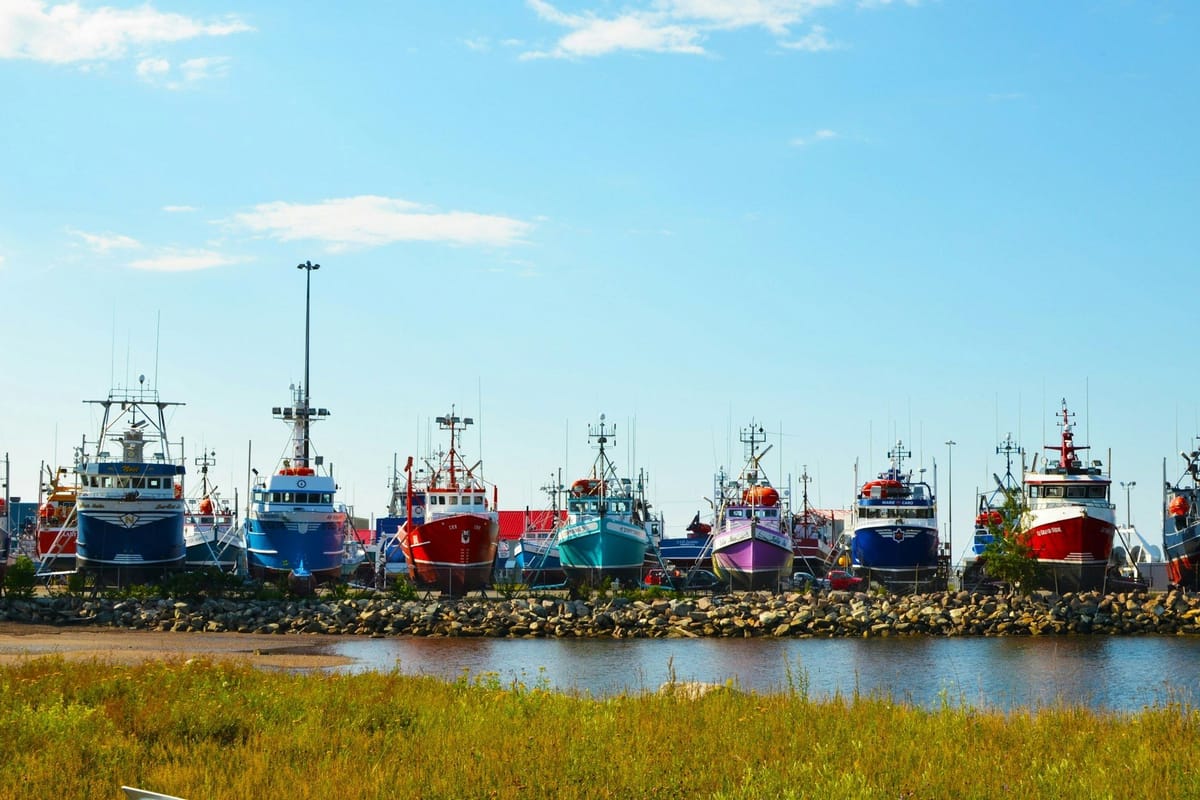
Photo by Leora Winter / Unsplash

Before a fishing vessel is built, a harbour upgraded, a fish farm expanded, or an offshore energy project approved, someone has to decide whether the project is worth financing. That decision, who makes it, on what criteria, and with what expectations of return, is where the future of the blue economy is actually determined. The ocean economy is not short of ambition. It is frequently short of capital structured in the right way, at the right scale, with the right time horizon.

The capital stack for ocean projects in Canada is more diverse and more specialized than the generic category of "bank financing" suggests. Different institutions finance different kinds of risk, and the distinctions decide whether a project moves from concept to funded reality.

Commercial Banks

Canada's large chartered banks, Royal Bank, TD, BMO, Scotiabank, CIBC, and National Bank, are the default starting point for most established ocean economy businesses. They are generalist lenders, not ocean specialists, applying standard commercial criteria: cash flow, collateral, management quality, repayment capacity, and operating history. For large ports, established shipping firms, seafood processors with stable export contracts, and aquaculture operations with a track record, conventional bank financing is usually available on conventional terms. The challenge is that many ocean economy projects do not fit those criteria cleanly. Vessels are specialized collateral. Fisheries licences derive their value from regulatory frameworks that can change. Aquaculture operations face environmental uncertainty that standard credit models are not designed to capture. Large banks tend to finance the established end of the ocean economy well and the emerging end poorly.

Credit Unions

Credit unions occupy a different position. They are not ocean specialists either, but their cooperative structure, community roots, and relationship-based lending model make them more relevant to the smaller-scale, community-embedded end of the ocean economy than their market share alone would suggest.

Among Canadian credit unions, the most relevant names are not necessarily the largest. Vancity stands out for demonstrated involvement in Indigenous and community-based fisheries financing, including a partnership with Coastal Nations Fisheries and the Native Fishing Association on vessel and gear financing for Indigenous fish harvesters. It does not specialize in ocean lending, yet it finances community-based, food-system, and conservation-linked ocean activity at a level few institutions match. Coastal Community Credit Union, based on Vancouver Island and serving coastal communities from Port Hardy to Victoria, is a natural relationship lender for ocean-adjacent businesses where local knowledge and long-standing community presence count, though its public materials do not describe a dedicated ocean finance strategy. UNI Financial Cooperation in Atlantic Canada reported fisheries loan portfolio growth of $22.6 million in 2022, among the clearest credit union examples of direct fisheries exposure in the region. Desjardins, while Quebec-based, is notable for a different reason: its sustainable finance framework explicitly includes certified fisheries and aquaculture as eligible categories, making it one of the few cooperative financial institutions in Canada to formally recognize those sectors within a structured lending program.

The broader point is that credit unions and Desjardins together hold roughly 20 percent of SME market share in Canada. In coastal communities, rural fishing economies, and Indigenous-led enterprises, that share is considerably higher. The relationship model that makes credit unions less competitive for large corporate transactions makes them more effective where local knowledge, community trust, and long-term relationships determine whether a project is viable.

Government Risk-Sharing Programs

One dimension of ocean economy financing that does not surface in most institutional profiles is the role of government programs in making conventional lending more viable. Lenders that might otherwise decline an ocean economy application because of unfamiliar collateral, sector volatility, or limited comparable data can access programs that absorb part of the uncertainty. That changes the risk calculation and allows capital to reach parts of the ocean economy it would not reach alone.

The Canada Small Business Financing Program provides an 85 percent government guarantee against eligible losses for qualifying small businesses borrowing up to $1.15 million. It is not ocean-specific, but it applies to marine service businesses, small tourism operators, processing facilities, and harbour-related operations that meet the eligibility criteria. In 2024-25 it supported 6,409 loans worth $1.9 billion across the Canadian economy.

Provincial loan boards fill a more targeted gap. Nova Scotia's Fisheries and Aquaculture Loan Board operates in partnership with provincial credit unions, creating a financing stream specifically designed for fish harvesters and sea farmers that combines the Loan Board's sector expertise with the credit union's relationship lending model. New Brunswick's Department of Agriculture, Aquaculture and Fisheries provides direct loans and loan guarantees for vessel purchases, aquaculture development, and equipment financing, financing up to 95 percent of eligible costs as a complementary lender after a private lender has been approached. These programs reduce downside exposure on collateral that conventional lenders find difficult to value, including vessels, fishing licences, and aquaculture equipment in thin resale markets.

The federal Indigenous Loan Guarantee Program is a more recent and potentially more consequential instrument. It can provide guarantees of between $20 million and $1 billion, with total authority of up to $10 billion, to support Indigenous ownership stakes in major projects. Early transactions have been concentrated in energy and infrastructure, but the program has no sector restriction that would prevent it from applying to ports, marine terminals, aquaculture operations, fisheries infrastructure, or coastal energy projects. Combined with FNFA's pooled borrowing model, it represents a significant and still-developing layer of financing capacity for Indigenous-led participation in the ocean economy.

BDC takes a different kind of risk-sharing role. Instead of guaranteeing a portion of a commercial loan, it frequently co-lends alongside conventional lenders, taking a subordinated position that reduces the senior lender's exposure. A bank prepared to provide 60 percent of a marine technology company's financing need may do so on the condition that BDC provides the remaining 40 percent. That co-lending model is a practical mechanism through which ocean economy projects that would not clear a conventional credit threshold get financed.

These programs do not replace private capital. They make private capital possible. Ocean finance is seldom just a borrower and a lender sitting across the table. There is usually a third participant: a government guarantee, a development bank tranche, a provincial loan board, or an Indigenous finance vehicle absorbing the uncertainty that would otherwise prevent the transaction from closing. Understanding that layer is part of understanding how ocean projects actually get funded in Canada.

Business Development Bank of Canada

Beyond the co-lending role described above, BDC is a federal Crown corporation with a mandate to support Canadian entrepreneurs and businesses that face financing gaps in the conventional market. For blue economy purposes that means growth companies, technology-focused businesses, and operators scaling into new markets, not established firms with conventional collateral. Ocean technology companies building sensors, autonomous systems, data platforms, and monitoring infrastructure are a natural fit. Aquaculture operators investing in recirculating systems or other capital-intensive innovation may find BDC more willing to finance future growth potential than a conventional lender focused on existing cash flow.

Export Development Canada

EDC tends to be overlooked in blue economy discussions, but its mandate connects directly to several ocean economy sectors: supporting Canadian companies doing business internationally, through financing, insurance, and guarantees. For seafood exporters, shipbuilding companies, marine equipment manufacturers, and ocean technology firms selling into international markets, EDC can be a significant part of the financing picture. Trade finance, accounts receivable insurance against foreign buyer default, and support for international contract execution are all within EDC's toolkit. A Canadian seafood processor exporting to European or Asian markets, or a marine technology company delivering equipment under an international contract, may find that EDC's instruments solve financing problems that conventional lenders are not equipped to address.

Canada Infrastructure Bank

The CIB occupies a distinct position in the capital stack. It is not a commercial lender and it is not trying to behave like one. Its mandate is to finance infrastructure projects that generate public benefits and have the potential to attract private capital alongside public investment. For the ocean economy that means ports, trade corridors, clean energy infrastructure, and Indigenous-led economic development at a scale that conventional lenders will not approach alone. The CIB committed $150 million to the CANXPORT logistics hub at Prince Rupert in 2024, its first investment in a Canadian port, and has been involved in financing associated with major port expansions. Its investment thesis is explicitly about projects that are too large, too complex, or too long-duration for conventional capital markets to finance efficiently without public participation. For project sponsors working at that scale, the CIB makes commercial financing possible by absorbing the risk profile that private capital will not take unassisted.

First Nations Finance Authority

FNFA is among the more consequential and least understood financing institutions in the Canadian ocean economy. It is a First Nations-owned pooled borrowing authority, not a bank, accessing capital markets on behalf of member First Nations governments and allowing communities to borrow at rates that reflect the strength of the collective pool, not the balance sheet of any individual Nation. Its financing has surpassed $4 billion since its founding, supporting an estimated 39,000 jobs and $8.5 billion in national economic output.

The ocean economy dimension of FNFA's portfolio is direct and growing. It provided $250 million toward the Mi'kmaq coalition's acquisition of Clearwater Seafoods' Canadian offshore fishing licences, part of the coalition's roughly $700 million investment and one of the most significant Indigenous fisheries ownership transactions in Canadian history. It provided approximately $1.4 billion, the largest loan in its history, to support the Haisla Nation's equity contribution to the Cedar LNG project on the BC coast. It has also supported coastal industrial infrastructure acquisition involving Atlantic Canada First Nations. These are transformative ownership events, and FNFA was the financing mechanism that made them possible. For Indigenous Nations with the fiscal governance frameworks that FNFA membership requires, it has become one of the most powerful tools available for moving from resource access rights to resource ownership.

Patient Capital and Conservation Finance

Not all ocean projects generate returns on timescales that commercial lenders can accommodate. Conservation finance, stewardship funding, and impact investing occupy the part of the capital stack where ecological outcomes are the primary return metric and financial returns, where they exist, are secondary or long-deferred.

Coast Funds, the Indigenous-led conservation finance organization in British Columbia, deploys capital into stewardship and economic development projects led by coastal First Nations outside the annual grant cycle. The Great Bear Sea Project Finance for Permanence, which closed in June 2024 with $335 million in committed capital, represents the most significant recent example of conservation finance structured around permanence, not project timelines. Its Marine Stewardship Fund is designed as a capital-preserving endowment generating long-term income for Guardian programs, marine protected area management, and collaborative governance. Philanthropic capital from Canadian and international foundations provided $75 million of the total, demonstrating that conservation finance at this scale requires instruments that sit well outside the conventional lending framework.

For ocean restoration, blue carbon project development, and stewardship infrastructure in communities where commercial returns are not the primary objective, patient capital from foundations, impact investors, and conservation finance organizations is not a supplement to the capital stack. It is the capital stack.

Venture and Early-Stage Capital

For companies building ocean technology, sensors, autonomous vessels, data platforms, marine AI, and robotics, the financing question is different again. These businesses are typically pre-revenue or early-revenue, with intellectual property and growth potential as their primary assets. Collateral-based lending is largely irrelevant. Venture capital, angel investment, and government innovation programs including BDC's venture arm are the relevant financing sources. The ocean technology sector in Canada is small relative to its international counterparts but growing, and the financing infrastructure supporting it is developing alongside it. This intersection of ocean economy and technology investment is where BDC, the National Research Council's Industrial Research Assistance Program, and provincial innovation funds tend to be more relevant than chartered banks or credit unions.

The capital available to ocean economy projects in Canada is more varied than it appears from outside the sector. What connects all of these institutions is not a shared definition of blue finance or a shared commitment to ocean outcomes. It is the more basic fact that each of them is making decisions about where capital goes and under what conditions, and those decisions collectively determine which parts of the ocean economy move forward, at what scale, and on whose terms. Understanding who provides the capital is one way of understanding how the ocean economy itself is governed.