Scientists and the Ocean Economy

A fisheries stock assessment does more than count fish. It can determine the quota, license value and borrowing capacity, and in some cases whether a coastal community can finance the economic participation its rights make possible.
Share
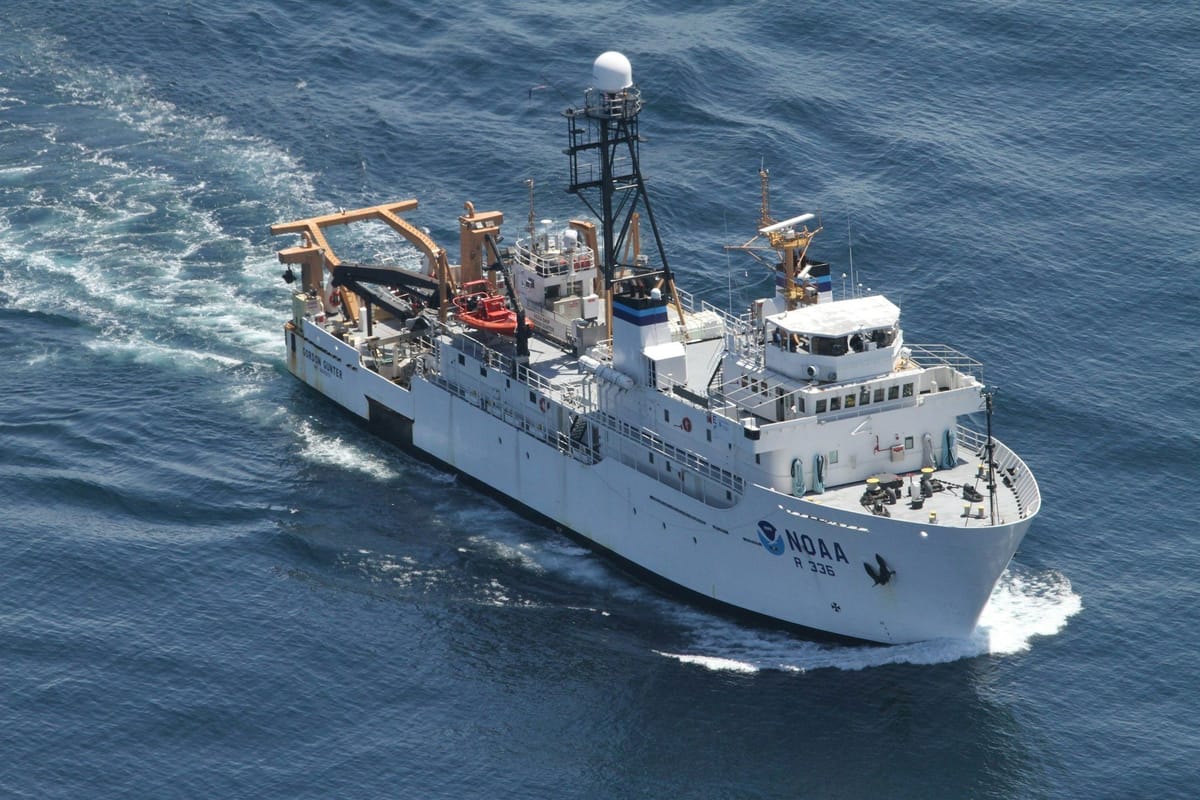
NOAA oceanographic research vessel underway at sea, viewed from above with scientific equipment visible on deck.
Photo by NOAA / Unsplash

For most of my career in financial services, a Phase 2 environmental assessment was about as close as lending decisions came to scientific input. A report would arrive before a real estate transaction, a risk team would note the findings, and the connection between what the science described and what capital actually did would remain narrow and transactional. What I understand now is that in the ocean economy that connection runs considerably deeper, and that scientific knowledge moves through the system in ways that standard financial analysis does not capture.

A fisheries stock assessment does not merely describe how many fish are in the water. It determines the quota. The quota determines the license value. The license value determines what a fishing company can borrow against. The borrowing capacity determines whether the fleet expands or contracts, whether processing infrastructure gets built, and in some cases whether an Indigenous community can finance the equity stake in a fishery that treaty rights have nominally made available. A revised biomass estimate, produced by a government science team working from survey data, can move through that chain and alter the economics of a coastal community within a single fishing season. The scientists who produced the estimate were not making economic decisions. They were measuring fish. The economic consequences followed from the measurement.

This pattern repeats across the ocean economy in ways that are rarely made explicit. Coastal flood modelling determines flood maps. Flood maps determine insurance availability. Insurance availability determines mortgage terms. Mortgage terms determine which coastal properties can be financed and at what cost. A modelling update that reclassifies a neighbourhood's flood risk from low to high does not require any storm to have occurred. The financial consequences arrive through the information system, not through the physical event. Sea level rise projections inform infrastructure design standards. Infrastructure design standards determine what ports, seawalls, and drainage systems cost to build and maintain. The capital cost of coastal adaptation is, in a real sense, a function of what ocean science says about how fast the water is rising and what the upper range of uncertainty looks like.

The ocean is unusually dependent on scientific observation because most of what matters about it is invisible. The decline of a fish stock below a productive threshold is not visible from shore. Ocean acidification cannot be seen or smelled. The accumulation of heat in the deep ocean leaves no mark on the surface that an untrained observer would notice. Shifting currents, declining oxygen levels, changing plankton distributions: none of these announce themselves in ways that allow markets, regulators, or communities to respond without the intermediary of measurement. In a forest, a logger can see what has been cut. On a farm, a farmer can observe what is growing. In the ocean, almost everything that matters requires instruments, vessels, satellites, and the scientific capacity to interpret what they produce. Without that capacity, there is no baseline against which change can be measured, no threshold against which risk can be assessed, and no early signal against which capital can be repositioned before the cost of inaction becomes clear.

Uncertainty, in this context, is not simply the absence of knowledge. It is itself an economic condition. Finance can work with known risk. A risk that can be measured, modelled, and assigned a probability can be priced into a loan, an insurance product, or a bond. Uncertainty, the condition where the range of outcomes cannot be reliably bounded, is harder to finance and harder to insure. The ocean economy contains genuine uncertainty at consequential scales. The threshold at which a fish stock shifts from recovery to collapse is not always knowable in advance. The point at which Atlantic overturning circulation crosses from weakening to severe disruption is contested among researchers working with the best available data. The upper range of sea level rise by 2100 depends partly on ice sheet dynamics that current models do not fully resolve. These are not gaps that will be filled by more effort alone. They reflect the genuine complexity of large, dynamic, interconnected systems. That complexity has a financial consequence: long-duration coastal infrastructure, fisheries investment, and insurance pricing in ocean-adjacent markets all carry a layer of irreducible uncertainty that scientific progress can narrow but not eliminate.

The lag between scientific observation and economic response is one of the more consequential features of the system. Scientific findings rarely move markets immediately. There is typically a sequence: observation, peer review, accumulation of evidence, scientific consensus, policy response, regulatory change, capital repricing. Each step takes time, and the total lag can run to decades. Atlantic cod stocks were showing signs of serious depletion in scientific assessments years before the 1992 moratorium. The connection between PFAS contamination and health risk was established in the scientific literature well before regulatory limits were set and litigation risk was priced into corporate balance sheets. Marine plastic accumulation was documented in scientific papers for years before it became a significant factor in consumer pressure, ESG screening, and extended producer responsibility regulation. During the lag, a gap exists between what the science knows and what capital has priced. That gap can represent either unrecognized risk or, in some cases, the window within which investment in adaptation or mitigation is still cost-effective.

Scientists working on ocean systems operate within constraints that affect what gets measured and how reliably. Monitoring programs depend on sustained funding across political cycles that often prioritize short-term spending over long-duration observation. The RAPID array measuring Atlantic overturning circulation has been operating since 2004, which is long enough to detect trends but short enough that separating structural change from natural variability remains difficult. Ocean monitoring satellites, research vessels, and seafloor sensor networks are expensive infrastructure whose value compounds over time but whose funding is perennially subject to budget pressure. When monitoring programs are cut or interrupted, the baseline degrades in ways that make subsequent risk assessment less reliable. The economic cost of that degraded baseline is rarely calculated explicitly, but it shows up eventually in the quality of the regulatory decisions, insurance models, and infrastructure design standards that depend on what the observation system has produced.

Indigenous knowledge systems add a dimension that instrument-based monitoring cannot replicate. Observations accumulated across generations of living in and from coastal and marine environments encode information about baseline conditions, variability, and change that scientific records extending back only decades cannot provide. Co-management arrangements in Canada have increasingly incorporated Indigenous knowledge into fisheries assessment and conservation planning, not as a cultural accommodation but as a practical improvement to the information system. The Haida Nation's involvement in Pacific halibut management, the Inuit knowledge informing narwhal population assessments, and the Guardian programs generating real-time stewardship data from coastlines that no government monitoring program reaches regularly are all examples of observation capacity that extends what science alone can see. The economic value of that extended observation is the same as the value of any other monitoring infrastructure: it reduces the blindness against which risk must otherwise be priced.

Science does not control the ocean economy. It does not set quotas, price insurance, approve permits, or allocate capital. What it does is determine the information environment within which all of those decisions are made. In that sense scientists are not standing outside the system commenting on it. They are part of the infrastructure through which the system operates. Capital flows toward what can be measured, modelled, insured, regulated, and forecast. In the ocean economy, science increasingly determines where those boundaries sit.