The Great Bear Sea Project Finance for Permanence
Most conservation funding runs out when the political cycle turns. The Great Bear Sea agreement was built to outlast that: $335 million, an endowment at its core, and Indigenous governance as the foundation, not the recipient.
Marine conservation isn't free. Guardians patrol on a schedule, salmon get counted in the same creeks every autumn, vessels come out of the water once a year for maintenance, and people expect to be paid in the quiet years as well as the eventful ones. None of it stops between grant cycles. Conservation money usually arrives as projects, with a start date, an end date and a deliverable. The Great Bear Sea Project Finance for Permanence closed on June 21, 2024, and the people who built it put the money into three funds with different lifespans, then wrote down what had to happen before any of it could be disbursed.
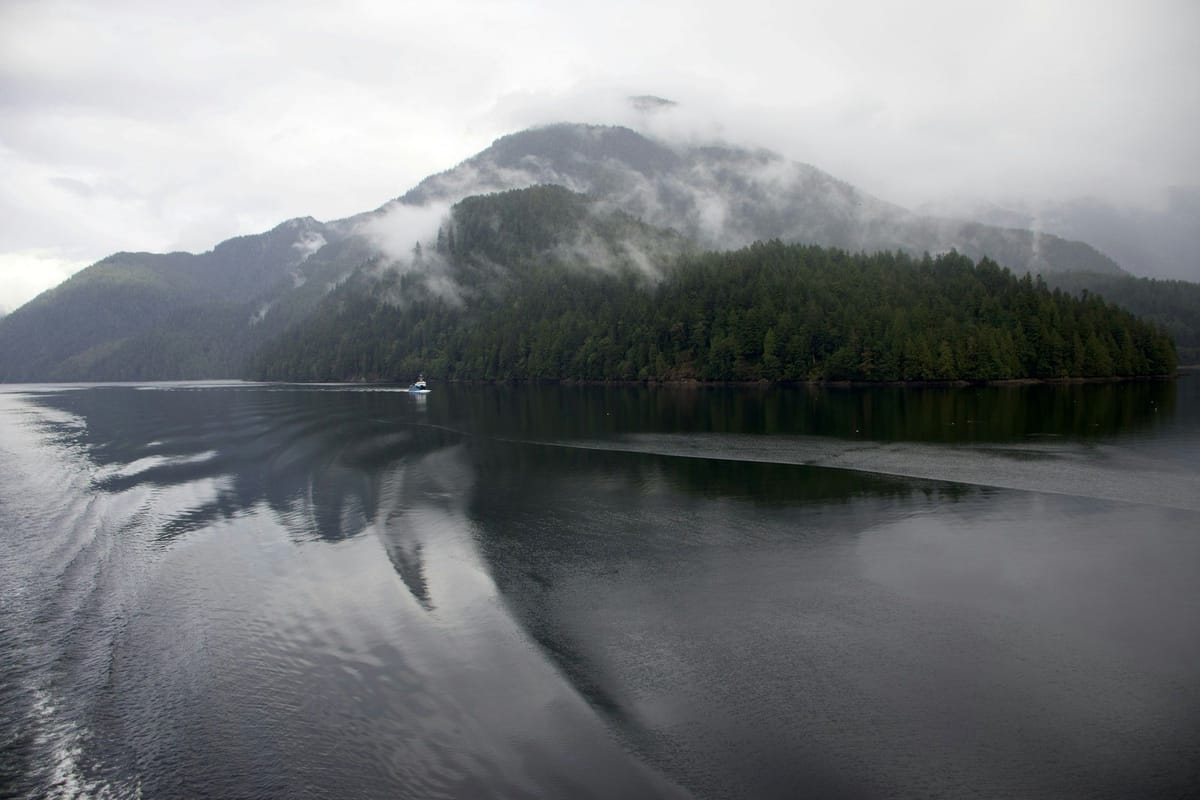
The agreement covers the Northern Shelf Bioregion, 10.2 million hectares of coast and shelf running from the north end of Vancouver Island to the Alaska border. Glass sponge reefs sit on the bottom of it, herring spawn along its edges, five species of Pacific salmon move through it, and humpbacks feed there in summer. Seventeen First Nations signed, along with Canada and the Province of British Columbia. Guardian programs, marine plans and stewardship staff were already working in these territories before any of this money arrived, which is the sequence Indigenous governance and blue finance in Canada describes. Canada contributed CAD 200 million, the province CAD 60 million and philanthropic donors CAD 75 million, for a total of CAD 335 million paid to Coast Funds. Canada also gave up its remaining offshore oil and gas tenures in the bioregion at the same closing.
Some of what a coastal community needs gets bought once. A runway upgrade at the Bella Bella airport, replacement fuel tanks at Hartley Bay, a forest tenure. Coast Funds calls the money for that spend-down funds, and there are two, holding CAD 168 million between them. The Community Prosperity Fund holds CAD 120 million of federal money at the Coastal Indigenous Prosperity Society, one of the two societies that make up Coast Funds. The grant agreement directs that it be disbursed over 10 to 15 years, and the agreement itself expires on March 31, 2040. The Marine Plan Partnership, or MaPP, is the marine planning process the province and coastal First Nations have run together since before this agreement, and its implementation fund holds CAD 48 million of provincial money. Coast Funds invests both in bonds and short-term instruments, so the money stays accessible and roughly level with inflation until a Nation asks for it.
The rest of the work has a payroll. Guardians, vessel maintenance, monitoring, and the coordination that collaborative governance takes up. That is the Marine Stewardship Fund, CAD 167 million: CAD 80 million federal, CAD 12 million provincial and the CAD 75 million from philanthropy. The Coast Conservation Endowment Fund Foundation, the second of the two societies, holds it and invests it as a single pool, but the agreements divide it into five separately tracked components. The phrase permanent endowment attaches to only one of them, the Site Fund. The published Endowment Contribution Agreement covers about CAD 48.7 million of it, contributed by Nature United, The Nature Conservancy, the Sitka Foundation and the Moore Foundation. Capital under that agreement cannot be disbursed at all, except where Coast Funds needs it to satisfy the minimum annual spending a registered charity owes under the Income Tax Act. The federal grant agreement is written differently. It says the funds will be managed with the objective of providing a permanent, self-sustaining source of income. It does not promise that every dollar of principal stays untouched.
Markets being what they are, the endowment's returns are lumpy. Coast Funds targets inflation plus 5%, and the stewardship work carries on in the years the portfolio does not deliver it. So each Nation gets a baseline allocation set in advance and paid out of realized gains. A reserve, held back from the original contributions, covers the shortfall in years when investment income does not reach that baseline. The reserve is there so a bad year in the markets does not become a bad year for the Guardian program. Income above the baseline can go back into the endowment, so keeping pace with inflation depends on the good years. In 2025 the portfolio returned 6.4% net of fees. Coast Funds moved CAD 14 million of that into Nations' allocations and disbursed close to CAD 18 million against approved projects.
Endowment income pays for operations, and 2025 gives a worked example. Coast Funds approved CAD 800,000 for the Wuikinuxv Nation's stewardship office: operations, research and management planning, the Guardian Watchmen program, equipment and training. Part of that work is creekwalking, counting salmon and taking samples in the Nation's own watersheds, which Wuikinuxv took over from Fisheries and Oceans Canada. A return on the portfolio set the allocation, the Nation applied against it, the board approved, and people went out and counted fish. Each of those is a separate step and none of them is a salmon run recovering. The reporting does not claim otherwise.
For the capital covered by the published Site Fund agreement, Coast Funds cannot disburse anything until two things exist: a signed funding agreement with the Nation, and evidence that the relevant protected area has been established under federal or provincial law. That is a condition precedent tied to establishment of the relevant protected area, rather than something Coast Funds or the Nation can satisfy through spending or reporting alone. Coast Funds supplies the evidence to Nature United, which acts as lead contributor for the philanthropic donors and is the only party that can waive the requirement, in writing and in advance. Failing to produce it is not an event of default, so nothing is forfeited and the money simply waits. Nothing similar governs the federal CAD 80 million or the spend-down funds. Finance follows governance usually describes a sequence. Here it is a term in a contract.
A marine protected area becomes legal when a minister designates it, and in this bioregion that happens by more than one route. Three sites were designated in the year to the end of 2025. Two are small refuges on Haida Gwaii, G̲aw K̲áahlii Masset Inlet at 22.42 square kilometers and X̲aana K̲aahlii Skidegate Inlet at 7.16. The third is the Banks Marine Refuge off the North Coast, 435 square kilometers of kelp stands and rockfish habitat. The network is meant to cover about 30% of the bioregion when it is finished, 2.8 million hectares of new and enhanced protection. On May 22, 2026, six Nations, Canada and British Columbia signed the Establishment Agreement for Mia-yaltwa Ha'lidzogm hoon, up to 6,700 square kilometers on the Central Coast, and the Nations declared an Indigenous Protected and Conserved Area over the same footprint under their own authorities. Parks Canada describes the reserve as established, with final boundaries, zoning and management planning still to come through the federal process. An establishment agreement, an Indigenous declaration and the management steps that follow are three different events.
The agreement carries a second number, CAD 742 million. That is the target of a 20-year financial plan. It assumes the CAD 335 million paid in, the investment income earned on it, and annual revenues from private-sector streams that did not exist at closing. The agreement records that an initial strategy for those revenues was still under review when the parties signed, and that the projected contributions from them have already been allocated among the 17 Nations. Nobody lends into this structure and nobody earns a return on it. The part of the plan that would have brought private capital in had not been built.
Coast Funds has been running an endowment and a spend-down fund side by side since 2007, which is long enough to see what each one does. The Great Bear Rainforest agreements put CAD 120 million into those two structures that year. The Economic Development Fund distributed CAD 61.4 million over 17 years and finished in 2024, on schedule and by design. It is gone, and that was always the plan. The Conservation Endowment started at roughly CAD 56 million and has paid out CAD 55.6 million for stewardship. It spends its investment returns and leaves the capital alone, so it can keep paying for work that never finishes.
A project finance for permanence agreement does not make conservation permanent. It divides spending by how long the obligation runs, and it holds part of the stewardship capital back until the relevant protected-area milestone is met. Fisheries authority, enforcement capacity and whether the salmon come back all sit outside what a financing structure can deliver, and these agreements do not claim otherwise. What gets decided at closing is how long each fund is meant to last and what has to happen before it pays.