Phytoplankton
In September 2019 the water off Newfoundland turned milky blue in the wrong month. What that colour is made of, and why somebody has been sampling the same spot in Halifax Harbour since 1992.

On September 1, 2019, a satellite passing over Newfoundland photographed the water southeast of the island running milky blue. On September 19 it was still there, and on the 22nd it was still showing through cloud. The colour came from coccolithophores, single-celled organisms of the species Emiliania huxleyi, which build themselves a covering of small chalky plates and shed them as they divide and die. The plates scatter sunlight back up through the surface and keep floating for a few days after the cell that made them is gone. Each cell runs about five microns across, roughly a thousand times smaller than a grain of sand, so it takes an extraordinary number of them to change the colour of an ocean enough for an instrument in orbit to pick it up.
Cynthia McKenzie, a marine biologist with Fisheries and Oceans Canada, said that was not the usual fall bloom in those waters, which would be made of diatoms, and she put it down to several weeks of sunshine and water warmer than normal. Barney Balch at Bigelow Laboratory said blooms of that species are common enough over the Grand Banks, just not in September, since they normally come nearer the summer solstice. Hurricane Dorian passed through in early September and the bloom carried on, and McKenzie thought the wave action may have brought nutrients up from deeper in the water column. Blooms like this one are ordinary. This one was in the wrong month.
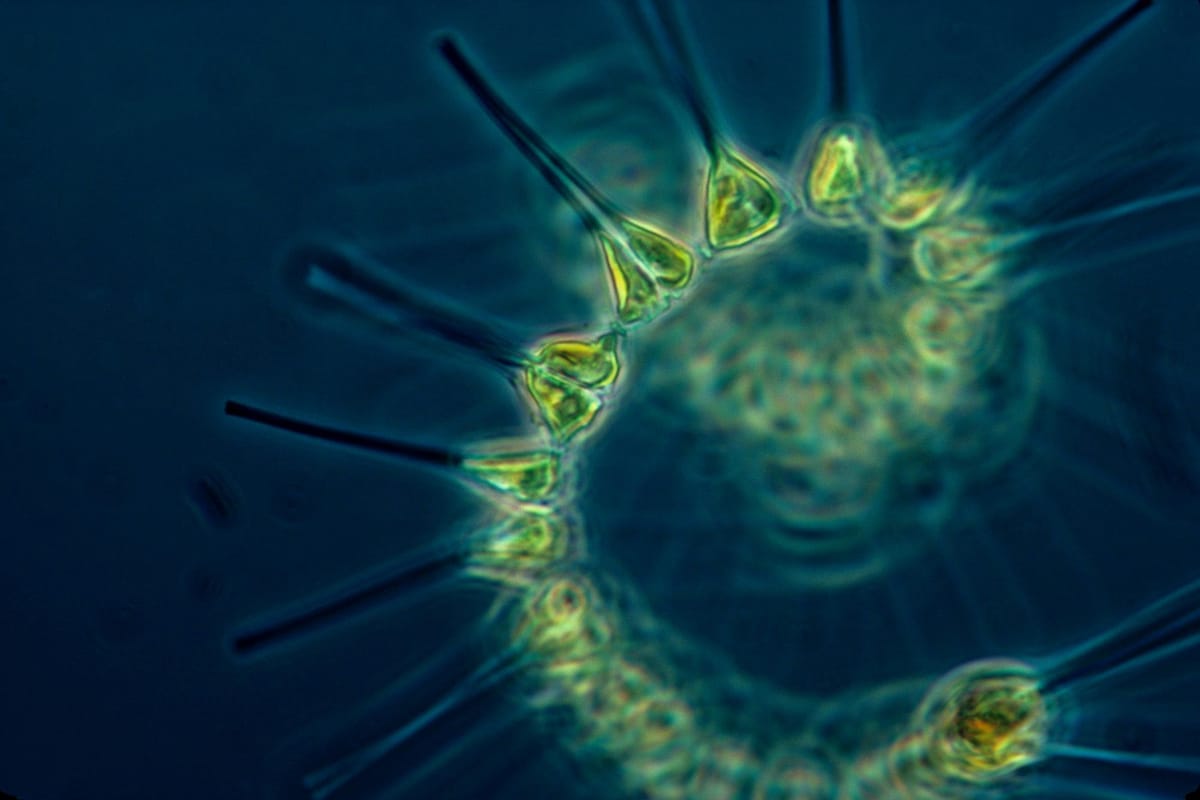
Phytoplankton are single-celled photosynthetic organisms that drift in the sunlit upper layer of the ocean. Diatoms build shells out of glass, silica drawn from the water. Coccolithophores build theirs out of chalk. Cyanobacteria build nothing and are smaller than either. What they share is the ability to turn sunlight, carbon dioxide, and dissolved nutrients into organic matter, and they do it at a scale that is difficult to hold in the head. NASA puts them at less than one percent of the photosynthetic biomass on Earth. They account for something close to half of all the photosynthesis that happens on the planet. NOAA's way of putting the oxygen side of it is that if you take two breaths, one of them came from the ocean, and the point is worth stating precisely: this is about half of annual oxygen production, not half of the oxygen already in the air, which accumulated over hundreds of millions of years.
Marine primary production runs to about 50 billion tonnes of carbon a year. That is the biological engine underneath the ocean food web, and it is also the top of a mechanism that moves carbon downward.
The mechanism is called the biological pump, and the interesting part of it is how much it leaks. Phytoplankton draw carbon out of the surface water. When they die, and when the zooplankton that eat them produce waste, some of that material sinks. Estimates of how much leaves the surface layer run between about 10 and 15 billion tonnes of carbon a year, which is roughly the same order as the carbon in all the fossil fuel the world burns. Most of that does not stay down for a century. Bacteria and animals eat the particles on the way through, and the carbon is respired back into the water and works its way to the surface again over years or decades. When researchers ask the narrower question, how much of it is still out of contact with the atmosphere a century later, the answer comes back somewhere between about 0.9 and 2.6 billion tonnes a year. So the pump is enormous and the sequestration is roughly a tenth of it, and the difference between those two numbers is a hundred years of things getting eaten on the way down.
A study published in 2025 put a price on the part that stays. Working only in waters beyond any country's jurisdiction, the authors valued the carbon storage the pump provides at about $545 billion a year, with a range from $471 billion to $694 billion, against 2.81 billion tonnes of carbon held for at least fifty years. It counts carbon and nothing else, so the oxygen and the fisheries and the climate regulation sit outside it. What it establishes is that the smallest defensible measure of one service from these organisms is already in the hundreds of billions.
The fisheries connection runs through the food web and it is not proportional. Phytoplankton feed zooplankton, zooplankton feed small fish, small fish feed larger ones, and every commercial fishery in the world sits at the end of that chain. NOAA looked at 64 major marine ecosystems and traced the line from primary production through ecosystem biomass to landings and then to revenue and employment, and found the connection held in nearly all of them. A 2024 study in Nature Communications took it further and modelled what a decline at the base does higher up. A 16 percent drop in phytoplankton produced a 38 percent drop in the fish biomass those waters could support, in intensively fished mid-latitude oceans. The loss more than doubles as it climbs.
Warming is pushing on that base through a physical route that has nothing to do with biology. Warm water is lighter than cold water, so as the surface warms it sits more stably on top of the colder, nutrient-rich water underneath, and less mixing means less nitrate and silicate reaching the phytoplankton in the lit zone. A study published in 2025 looked at satellite chlorophyll between 45 degrees north and 45 degrees south from 2001 to 2023 and found significant declines across 32.4 percent of that area against significant increases across 17.6 percent. The picture is not uniform and the study says so. Some high-latitude water is becoming more productive as ice retreats and the growing season lengthens.
Acidification is a harder question and it is worth being straight about how open it still is. Dissolved carbon dioxide changes the chemistry that calcifying species depend on to build their plates, and it would be reasonable to expect the coccolithophores to suffer for it. The evidence does not line up that way. A 2025 review of the calcifying plankton found no unifying trend across species. Some respond badly, some do not, and the responses interact with temperature and nutrients and light in ways nobody has untangled. What is well established is that these organisms matter to how carbon moves, since their chalk plates both weigh sinking material down and, in making the chalk, release carbon dioxide back into the surface water. Which way the balance tips under changed chemistry is not settled.
Most of what is known about any of this in Canada comes from people going out in a small boat, over and over, to the same spot. There is a station in Bedford Basin, at the top of Halifax Harbour, marked by a compass buoy over the deepest water in the basin at 71 metres. Since 1992 somebody has gone out there roughly every week and pulled water samples from 1, 5, 10, and 60 metres and counted what was in them. The record that has accumulated shows the thing a single survey never would. In 1992 the spring bloom arrived in the seventeenth week of the year and was thin, about 7 milligrams of chlorophyll per cubic metre. In 1993 it arrived in the fourth week and hit 28. Same buoy, same bottles, same basin, and a bloom that came thirteen weeks earlier and four times as strong.
In 1998 Fisheries and Oceans built a wider version of that habit, the Atlantic Zone Monitoring Program, which samples fixed lines and stations from the Gulf of Maine to the Labrador Shelf, including Station 2 on the Halifax Line and Station 27 off St. John's. The measurements are unglamorous: nutrients, chlorophyll, cell counts, a net dropped and hauled back. What they produce is the record that would show whether the base of the food web on this coast is arriving earlier, thinner, or in different species than it used to. There is no way to infer that from a good year's catch, and no satellite sees the bottom 60 metres of a fjord. Somebody has to go out in the boat.