Kelp Forests

Kelp grows up to half a metre a day and builds underwater forests that rival reefs for biodiversity. Along the BC coast, marine heatwaves, sea star disease, and exploding urchin populations are turning those forests to bare rock.

Share
Kelp Forests
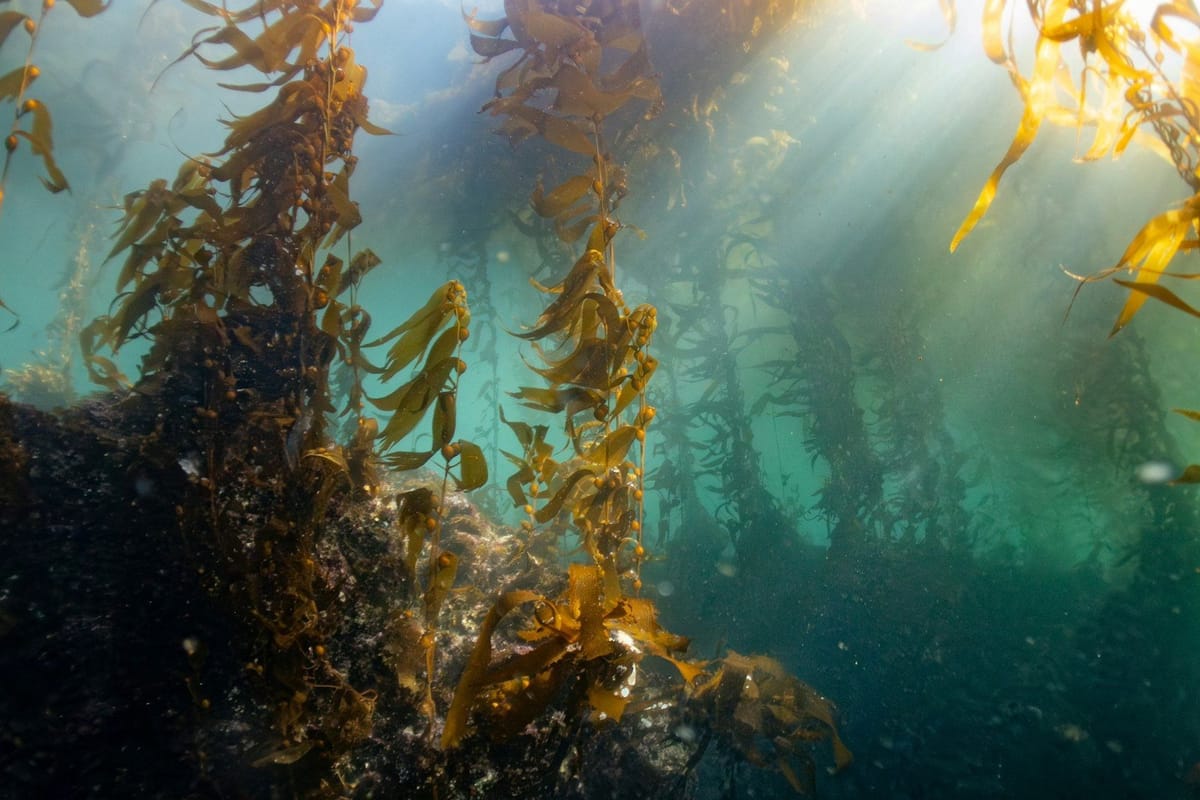
Photo by Erick Morales Oyola / Unsplash

Kelp is not a plant. It is a brown algae, more closely related to the single-celled organisms that cause harmful algal blooms than to the trees it structurally resembles. Under the right conditions it can grow up to half a metre per day, anchoring itself to the rocky seafloor with a root-like structure called a holdfast and extending blades toward the sunlit surface through a flexible stalk called a stipe. The result is a three-dimensional forest in the water column that functions ecologically like a terrestrial forest, providing canopy, understorey, and floor habitat for hundreds of species, without sharing any evolutionary history with one. That parallel between a kelp forest and a land forest is the most useful entry point for understanding what kelp forests are and why their condition matters.

Kelp forests grow in cold, nutrient-rich coastal waters, typically between one and thirty metres deep, along temperate and subpolar coastlines on every continent except Antarctica. They require rocky substrate for attachment, clear water for light penetration, and the cold upwelling that brings nutrients from depth to the sunlit zone where they grow. Canada’s Pacific coast, from the exposed outer coast of Vancouver Island to the sheltered waters of the Salish Sea and north through Haida Gwaii and the central BC coast, supports extensive kelp forest ecosystems dominated primarily by bull kelp and giant kelp. Atlantic Canada also has kelp forests, though they are less studied and less publicly visible than their Pacific counterparts, with species including sugar kelp and horsetail kelp growing along rocky shores from Nova Scotia to Labrador.

The ecological services that kelp forests provide follow from their structure. The three-dimensional habitat they create supports extraordinary biodiversity. Rockfish, lingcod, and dozens of other commercially important species use kelp forests as feeding and nursery habitat. Sea otters, once hunted to near-extinction along Canada’s Pacific coast and now slowly recovering in parts of their former range, are keystone predators in kelp forest ecosystems, controlling the sea urchin populations that would otherwise graze kelp to bare rock. Harbour seals, Steller sea lions, and various seabird species feed within kelp forests. The structural complexity of the canopy and understorey supports communities of invertebrates and smaller fish that in turn support larger predators, creating food webs of a density and diversity that open coastal waters cannot approach.

Kelp also contributes to carbon cycling, though its role is less straightforward than that of mangroves or seagrasses. Kelp grows rapidly and sequesters carbon in its tissue, but unlike the deep peat soils that accumulate under mangroves and salt marshes, much of the carbon in kelp biomass is released back into the water column when the algae dies and decomposes. Some fraction sinks to the deep ocean where it may be sequestered for centuries, but the proportion and the mechanisms are still being actively researched. The scientific consensus on kelp as a blue carbon ecosystem is less settled than for mangroves or seagrasses, which has made it harder to incorporate into carbon market frameworks despite the ecological importance of the forests themselves.

In British Columbia, kelp forests are under pressure from multiple directions simultaneously. Water temperatures along the BC coast have risen significantly over the past two decades, with marine heatwave events in 2014 to 2016 and again in 2019 to 2021 driving kelp loss across large sections of the coast. Warmer water is less nutrient-rich, which slows kelp growth and reduces the canopy density that the ecosystem depends on. Sea urchin populations, normally kept in check by predators including sea otters and sunflower sea stars, have exploded in some areas following a sea star wasting disease that decimated sunflower sea star populations along the Pacific coast from 2013 onward. Without predator control, urchins can graze kelp forests down to bare rock, creating what ecologists call urchin barrens, stretches of seafloor where kelp once stood but cannot re-establish because urchins consume any new growth before it can take hold.

Kelp has attracted less conservation finance than coral reefs or mangroves, for two reasons. The carbon accounting is unsettled, and the forests are scattered along temperate coastlines instead of concentrated in the jurisdictions where conservation finance has been most active. Restoration efforts in BC have included manual removal of urchins in targeted areas to allow kelp recovery, a labour-intensive approach that has shown local success but that requires sustained funding without a clear revenue pathway to offset costs. Urchin harvesting for seafood markets, particularly for export to Japan where sea urchin roe is a high-value product, has been proposed as a way to align commercial incentives with conservation outcomes, turning an ecological problem into an economic opportunity. Several pilot programs are underway in BC, though the scale needed to make a meaningful difference in urchin pressure across a coastline of BC’s extent remains a significant challenge.

Kelp forests show how interconnected the pressures on a marine ecosystem can be. Warming water, disease, predator loss, and the cascading consequences of those changes operate at once and interact in ways that single-issue interventions cannot fully address. Financing that holds up in that context has to be as adaptive as the system it is trying to protect.