Mangroves

Mangroves grow where no other tree can, rooted in salt water and oxygen-poor mud. They pack several times the carbon of upland forest into the same area, blunt storm waves, and shelter young fish. Cleared, they flip from carbon sink to carbon source.

Share
Mangroves
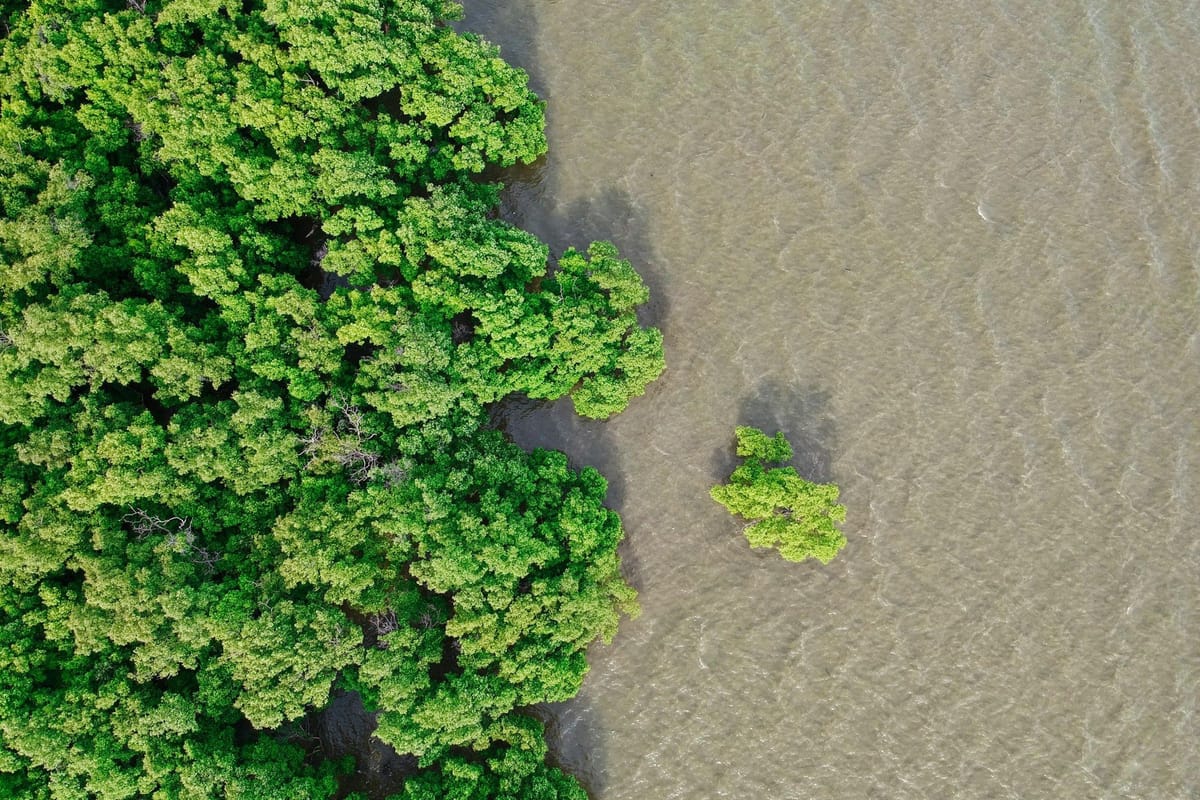
Photo by Waranont (Joe) / Unsplash

A mangrove tree grows where almost nothing else can. Its roots reach into waterlogged, oxygen-poor sediment along tropical and subtropical coastlines, anchoring the tree against tidal currents while a network of aerial roots extends above the mud surface to absorb the oxygen that the soil cannot provide. The result is a tree that stands in salt water, filters salt through its leaves or roots depending on the species, and builds habitat in the intertidal zone between land and sea that would otherwise be bare mud or open water. That capacity to survive where other trees cannot is the physical basis for everything else mangrove forests provide.

Mangroves occupy roughly 150,000 square kilometres of coastline across more than 100 countries, concentrated in tropical and subtropical regions of Asia, Africa, and the Americas. That area is a fraction of what it once was. Mangrove forests have been cleared for shrimp aquaculture, coastal development, and agriculture at rates that have reduced global coverage by roughly a third to a half over the past five decades depending on the region and the methodology used to estimate historical extent. The losses have slowed in some regions as conservation awareness and policy attention have grown, but in others clearing continues. What has changed most is the understanding of what is being lost when a mangrove forest disappears.

The carbon storage capacity of mangroves is disproportionate to their area. Mangrove soils accumulate organic matter over centuries, building carbon stocks that can reach several times the levels found in tropical upland forests of equivalent area. When mangroves are cleared, that stored carbon is released, in many cases rapidly, as the waterlogged soil that has preserved it for decades or centuries is exposed to oxygen and begins to decompose. A cleared mangrove does not just stop storing carbon. It becomes a source of it. That dynamic makes mangrove conservation one of the highest-value blue carbon opportunities available, and it has driven significant interest from both conservation funders and carbon market developers in protecting and restoring mangrove ecosystems.

The coastal protection function of mangroves operates through the same root system that makes the trees distinctive. The dense, interlocking aerial roots slow water moving through the forest, dissipating wave energy and trapping sediment. During storm events, intact mangrove forests can significantly reduce the height and force of waves reaching inland areas behind them. Studies following major tropical cyclones have documented lower damage in coastal communities protected by mangroves compared to those where the forest had been cleared. As tropical storm intensity increases with rising ocean temperatures, the value of that protection function is rising alongside it, a service whose financial equivalent in engineered coastal defences would be substantial.

Mangroves also shelter the young of many commercially fished species, the juveniles that later move out to reefs and open water. The structural complexity of the root system provides shelter for juvenile fish and invertebrates during the vulnerable early stages of their development. Many commercially important species, including snapper, barramundi, and various shrimp, spend part of their life cycle in mangrove habitat before moving to reefs or open water as adults. Mangrove loss therefore affects fisheries yields in ways that the fisheries data does not readily attribute to habitat change, because the connection between a cleared mangrove and a reduced catch happens across years and across species rather than immediately and visibly.

Canada does not have mangroves. The climate conditions they require, warm temperatures year-round and a frost-free coastal zone, do not exist on Canada’s Pacific, Atlantic, or Arctic coasts. The Canadian relevance is indirect but real. Canadian financial institutions carry exposure to mangrove-dependent coastal economies through trade finance, insurance, and investment in regions where mangrove loss is accelerating. FinDev Canada, Canada’s development finance institution, has invested in blue finance instruments in jurisdictions where mangrove conservation is part of the financing strategy. And the blue carbon accounting frameworks that inform Canadian climate policy draw heavily on mangrove carbon science, since mangroves are among the best-studied and most carbon-dense of the coastal ecosystems that blue carbon finance aims to protect.

The financing landscape for mangrove conservation has developed alongside the broader blue carbon field. Debt-for-nature swaps in Belize and Ecuador have included mangrove protection as part of their conservation commitments. Blended finance structures have been used to fund mangrove restoration projects in Indonesia, the Philippines, and East Africa, combining public and philanthropic capital with private investment in sustainable fisheries and coastal tourism that depend on healthy mangrove ecosystems. The measurement and verification infrastructure for mangrove carbon credits is more developed than for most other blue carbon ecosystem types, which has made mangroves a preferred entry point for voluntary carbon market buyers seeking nature-based ocean credits with credible science behind them.

The case for mangrove conservation is not difficult to make. The ecological services are real, the financial value is measurable, and the connection between a standing mangrove forest and a functioning coastal economy is direct enough to be visible without sophisticated modelling. What has historically been difficult is assembling the governance, tenure security, and long-term financing commitments that durable conservation requires. That is where the blue finance field is most actively working, and where the most consequential progress is still to be made.