Canadian Blue Finance
How Do We Know What We Are Doing to the Ocean?
Collecting marine data has become cheaper, but measuring human impact hasn't. Why observation, interpretation, and assurance present three distinct hurdles.
How is blue finance developing in Canada? These articles examine bank lending, public investment, conservation finance and the information used to make financial decisions, including where existing approaches struggle to account for ocean-related risks and opportunities.
Canadian Blue Finance
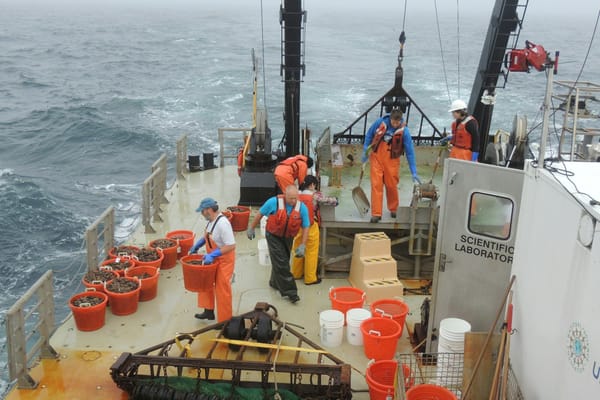
Collecting marine data has become cheaper, but measuring human impact hasn't. Why observation, interpretation, and assurance present three distinct hurdles.
A bank can be diversified by geography, sector and borrower, yet still depend on the same natural system. Canadian concentration rules do not ask banks to look for that exposure.
Canadian Blue Finance
Flood, fisheries exposure, port disruption. Each one sits on a bank's register as its own category, and the ocean condition connecting them sits on none of them. What OSFI's climate guidance measures, what it leaves out, and why a risk nobody can measure well ends up mispriced.
Canadian Blue Finance
Canada has spent hundreds of millions establishing marine protected areas. The harder question is whether the funding and governance behind them are built to last as long as the protection itself.
Rules & Regulation
Not all ocean protection is equal. Less than half a percent of Canadian waters are strongly protected; the rest is a patchwork of partial restrictions across three federal departments and a fourth, looser category. A designated area without staff, budget, and monitoring is just a boundary on a map.
Canadian Blue Finance
Canada has no federal protocol for coastal carbon and no settled answer to who would own a credit. What would have to be in place before a Canadian salt marsh or eelgrass meadow could sell carbon, and why Australia's protocol did not solve it.
Canadian Blue Finance
Canadian banks can classify a sustainable asset, sell a federal bond that funds marine conservation, and structure a blue bond in Mexico. What I cannot find is the condition of the ocean inside a Canadian credit decision.
Canadian Blue Finance
Fishing and trapping accounted for CAD 1.414 billion of Canadian bank lending in the first quarter of 2026, against CAD 58.983 billion for agriculture. The rest of a bank's ocean exposure is booked under whatever the borrower happens to be, and no supervisory return asks anyone to add it up.
Analysis & Evidence
In 2024, more than 250 Canadian financial institutions mapped their loan books against flood and wildfire hazard. What that exercise could see, and what it could not, is the more useful guide to where blue finance stands.
Canadian Blue Finance
The question in April was which projects a CAD 25 billion federal fund would carry that were not being carried already. A September update on what has and has not been settled since.
Canadian Blue Finance
Canada built the financing structure the conservation world now copies, and it works. It also set out to establish sixteen new marine protected areas by 2025 and established one. The part of that shortfall money could have fixed is smaller than it looks.