Can a Bank Be Concentrated in the Ocean?
A bank can be diversified by geography, sector and borrower, yet still depend on the same natural system. Canadian concentration rules do not ask banks to look for that exposure.

Canada finished consulting on its Sustainable Finance Taxonomy this month. The comment period on the draft methodology report closed on 13 August, and the work behind it will settle how green, transition and abatement activity gets defined across six priority sectors. Strip away the subject matter and the exercise is an argument about categories. Once an activity has a category it can be identified, compared, measured and carried into a decision. Without a common category, it is much harder to see consistently across companies and portfolios.
There is a second classification problem in Canadian finance that draws far less attention, and it sits inside prudential risk management. Guideline B-15 expects federally regulated institutions to aggregate climate-related exposures and identify where they cluster, by geography, by sector, by product and by counterparty, and to incorporate climate-related risks into their assessment of capital adequacy. It has applied to the large banks since fiscal 2024 and to the rest of the federally regulated sector since fiscal 2025. Those four axes determine where a lender is expected to look for a concentration.
The two documents do different jobs and should not be run together. One classifies economic activity to help investors and lenders identify climate-aligned investment. The other classifies risk so institutions can manage it. What they share is that both work by naming things, and what gets named is what becomes visible in a financial decision. Concentration is the clearest case of this, because a concentration exists only in relation to whatever you are aggregating by. Change the axis and a portfolio that looked diversified can stop looking that way.
Which is where the useful question arrives. B-15 asks whether a lender's exposures cluster by geography, sector, product and counterparty. It does not ask whether a group of borrowers depends on the same natural system.
So the machinery exists. Banks have been finding concentrations in commercial real estate, in industries and in connected borrowers for decades, and B-15 extends that discipline to climate. Nothing in what follows calls for a new mechanism. It calls for one more axis.
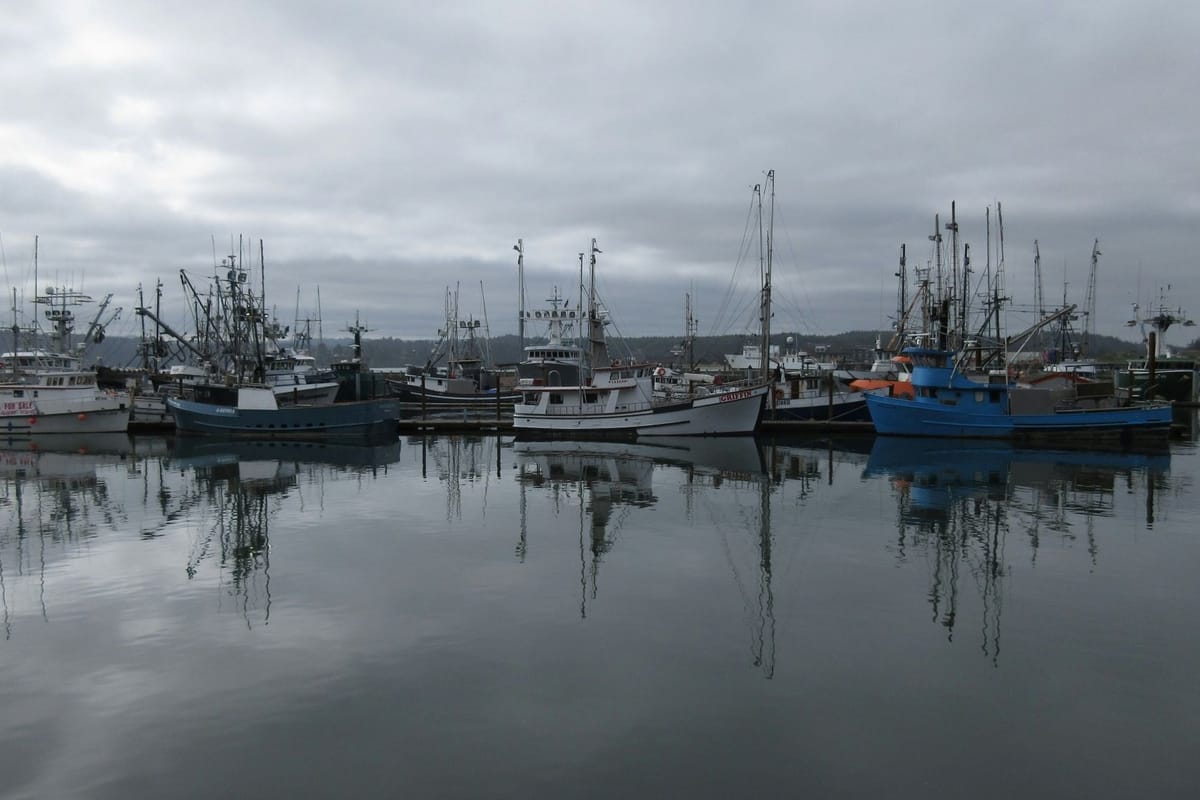
The Nova Scotia Fisheries and Aquaculture Loan Board reported $351.4 million of loans receivable at 31 March 2025, and its audited statements record that all of its clients are in fishing, aquaculture or supporting industries. Those borrowers do not share one ecological exposure. A lobster harvester, a salmon operation and a seafood processor depend on different conditions in different ways, and no single stock sits underneath all of them. But the portfolio looks different depending on the question you bring to it. Ask what sector these borrowers are in and you get one answer. Ask what productive natural systems their cash flows rest on and a second kind of concentration appears, one the major Canadian prudential frameworks do not ask lenders to identify.
B-15 is expressly a climate document. It defines physical risk as the financial risk from the increasing severity and frequency of climate-related extremes and events, longer-term gradual shifts of the climate, and indirect effects of climate change, which reaches well beyond damage to property. But when the guideline illustrates how physical risk arrives in credit risk, its worked example is damage to collateral, producing a higher loan to value ratio and a higher loss given default. A stock that declines from fishing pressure sits outside that climate framing altogether. The words biodiversity, ecosystem, natural capital, marine, ocean and fisheries do not appear in the current version.
This is not only a federal question. Quebec's Autorité des marchés financiers maintains its own climate risk guideline covering insurers, cooperatives and deposit institutions. British Columbia's commercial lending guideline for credit unions carries a principle on natural catastrophe and climate risk, alongside an older requirement covering site contamination and the lender liability that can follow from it. Ontario weighs environmental, social and governance risk in credit union supervision with an emphasis on climate. Climate, catastrophe, contamination, ESG. Each treats the environment as something that can damage an asset or create a liability. None of them asks whether the value of a business rests on a natural system continuing to function.
The international supervisory view has moved, and in a direction that matters here. In April the Network for Greening the Financial System published a note on the supervision of nature-related financial risks. Its position is that supervisors can integrate these risks into traditional risk categories, including credit, market and operational risk, and build on the climate supervision already in place, because climate-related risks are a sub-category of nature-related risks. Read that way, a climate framework is the smaller box inside a larger one. Both the Bank of Canada and OSFI are members of the NGFS. The European Banking Authority has already made a version of this binding, in guidelines that have applied to most institutions since 11 January 2026 and require large institutions to identify sectors highly dependent on ecosystem services.
One piece of work sits underneath all of that. In 2023, researchers at the European Central Bank took borrower dependence on ecosystem services, mapped it against credit register data covering more than four million companies and over four trillion euros of loans, and found that almost three quarters of euro area corporate lending goes to firms with a high dependency on at least one ecosystem service. The method has limits worth stating. Dependency is scored by sector rather than by location, and where classifications overlapped the researchers took the highest applicable score. The finding is not that three quarters of European loans are impaired. It is that a very large share of corporate credit sits with borrowers whose activity depends materially on ecosystem services. What matters here is the last step. They aggregated those dependencies at the level of each bank’s loan portfolio, weighted by exposure. That is the concentration measure no Canadian framework asks for, and it has already been built and run.
Canada holds pieces of the raw material. The Bank of Canada publishes chartered bank lending by industry every quarter, including a line called fishing and trapping, which stood at $1.414 billion in the first quarter of this year against $58.983 billion for agriculture. Statistics Canada published the first monetary valuation of Canadian ocean ecosystem services this past January, at $7.1 billion for 2023. Neither is a dependency measure, and setting them side by side would not produce one. The European work used borrower-level credit data mapped against sector dependency scores, and no public Canadian equivalent of that mapping exists. Nor is there a published national series showing credit union lending to fisheries or aquaculture, where shared dependencies could be particularly concentrated.
The vocabulary is moving toward mainstream standard-setting in any case. The International Sustainability Standards Board has taken its nature-related work from research into standard-setting and authorised balloting of an exposure draft for a proposed IFRS Practice Statement on nature-related disclosures, targeted for publication in October, drawing on the work of the Taskforce on Nature-related Financial Disclosures. The Canadian Sustainability Standards Board is following that work, and OSFI has already revised B-15's disclosure expectations once to align with Canada's first sustainability disclosure standards. The concepts would not have to be invented here.
Which leaves a question for anyone carrying coastal exposure. B-15 asks where a portfolio concentrates by geography, sector, product and counterparty. It does not ask what the borrowers depend on. A shared dependency can exist economically whether or not the taxonomy has a field for it. Without that field, it is much less likely to become visible at the level of the portfolio.