How Tides Work

Tides are gravitational and perfectly predictable. So why can two coastlines a few hundred kilometres apart differ by a factor of ten, and why does the Bay of Fundy have the highest tides on the planet?

Share
How Tides Work
Photo by Stephen Walker / Unsplash

Twice a day, in most places, the ocean rises and falls. The timing is predictable enough to be charted years in advance. The mechanism is gravitational, operating at a scale that makes wind and weather look local by comparison. And yet the actual tidal range, the difference between high water and low water, varies so dramatically from one location to another that two places a few hundred kilometres apart can experience tides that differ by a factor of ten or more. Understanding why requires looking at both the forces that drive tides and the local geography that determines their range.

The gravitational pull of the moon is the primary driver. As the moon orbits the earth, its gravity pulls on the ocean, creating a bulge of water on the side of the earth closest to the moon and, through a combination of gravitational and centrifugal effects, a corresponding bulge on the opposite side. As the earth rotates beneath these bulges, most coastal locations pass through two high tides and two low tides in roughly twenty-four hours. The sun exerts a similar but weaker gravitational pull. When the sun and moon align, at new and full moon, their combined pull produces higher high tides and lower low tides, known as spring tides. When they are at right angles, the forces partially cancel, producing the more moderate neap tides.

Those forces are consistent and predictable. What they do not explain is why the tidal range at Mont-Saint-Michel in France reaches fourteen metres while the tidal range in the Mediterranean barely reaches half a metre, or why the Bay of Fundy in Nova Scotia regularly sees tidal ranges between twelve and sixteen metres, the largest on the planet. The answer lies in resonance.

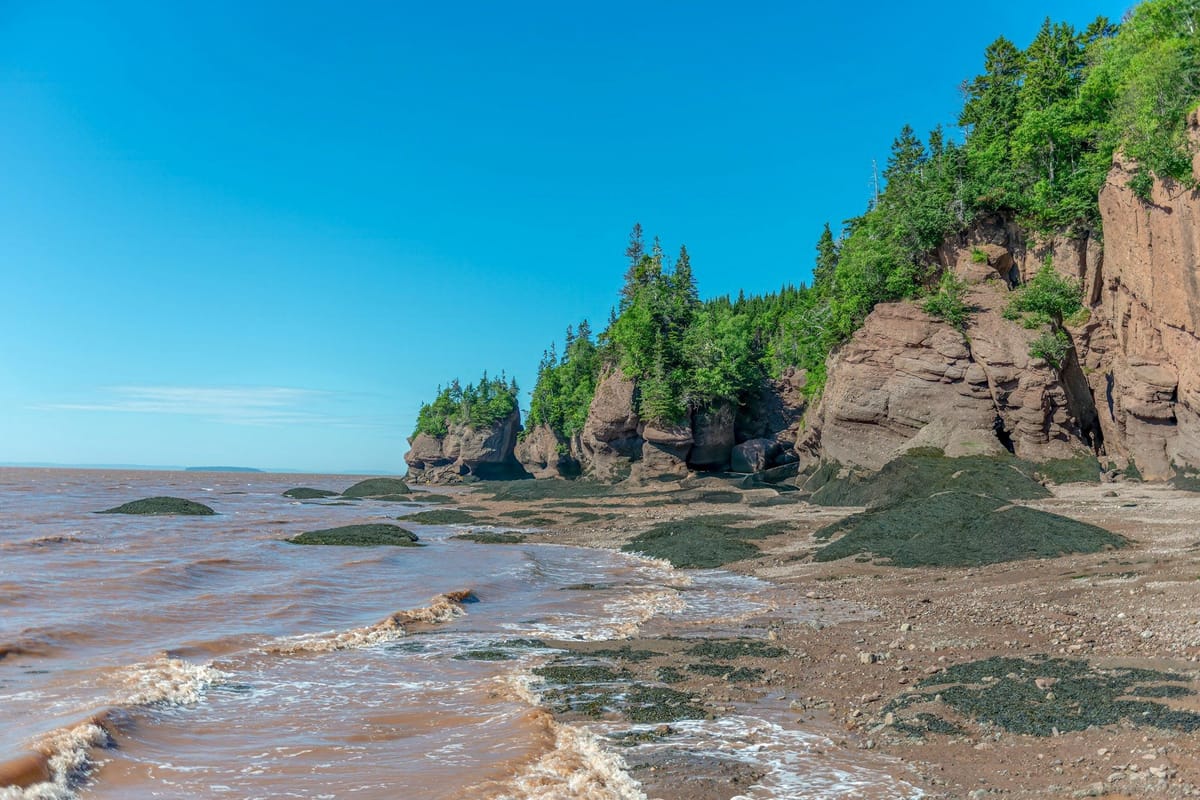
Every enclosed or semi-enclosed body of water has a natural oscillation period, the time it takes for a wave to travel from one end to the other and back. When that natural period closely matches the frequency of the tidal cycle, roughly twelve and a half hours for a semidiurnal tide, the tides amplify dramatically. The Bay of Fundy is approximately the right shape and size to resonate with the tidal frequency. Each incoming tide pushes water into the bay just as the previous oscillation is returning, and the two reinforce each other in the same way that pushing a child on a swing at the right moment amplifies their motion. The result is a tidal range that can expose kilometres of seafloor and raise water levels by the height of a four-storey building in the space of six hours.

That extreme tidal range defines everything about the Bay of Fundy's ecology and economy. The twice-daily exposure and inundation of vast intertidal mudflats creates one of the most productive shorebird habitats in the Western Hemisphere, with millions of migrating birds stopping to feed on the invertebrates exposed at low tide. The tidal currents that move such large volumes of water in and out of the bay also create conditions that have made the region one of the most studied tidal energy sites in the world.

Tidal energy captures the kinetic energy of moving water, not the potential energy of the water-height difference used in conventional hydroelectric dams. The strong, predictable currents in the Minas Passage at the head of the Bay of Fundy have been the focus of in-stream tidal turbine development for more than fifteen years. The predictability of tidal energy is its most significant advantage over wind and solar: tides follow an astronomical calendar that can be calculated years or decades in advance, making tidal generation dispatchable in a way that other renewable sources are not. The financing challenge has been the harsh operating environment. Tidal turbines in the Minas Passage face currents strong enough to stress and damage equipment in ways that are difficult to predict and expensive to manage remotely. Several demonstration projects have operated successfully for limited periods, and the technology continues to develop, but commercial-scale tidal energy from the Bay of Fundy remains a promising prospect, not an operating reality.

In the Arctic, tides interact with sea ice in ways that create additional complexity for navigation, community supply, and marine operations. The timing of tidal cycles affects when ice is most stable or most likely to fracture, which is critical for communities whose hunting and travel depend on safe ice conditions. As sea ice extent declines, tidal dynamics in Arctic coastal waters are changing in ways that are still being characterized.

Tides are the ocean's most predictable feature and in some respects its most consequential for coastal human activity. Port operations, fisheries access, coastal infrastructure design, and tidal energy development all depend on understanding not just that tides exist but how they behave in specific places, why those places differ so dramatically from each other, and how changes in sea level will alter tidal dynamics in coastal communities over the coming decades.