Shipping and Ports: Trade, Geopolitics, and Supply Chain Risk
In 2024, Canadian supply chains absorbed strikes, rerouting, drought, and wildfire at once. The exposures behind that year are structural, and they change how port and shipping assets should be financed.

In 2024, Canada’s marine and rail supply chains absorbed simultaneous CN and CPKC labour lockouts, strikes at the ports of Vancouver and Montreal, Red Sea conflict rerouting global container shipping, Panama Canal drought restricting vessel transit, and wildfire impacts on western rail corridors. Statistics Canada’s monthly GDP data captured the result: water and rail transportation rebounded in December after strike and lockout activity ended in November, while October saw measurable declines linked to Montreal terminal disputes and intermodal disruption. None of these were isolated incidents. They were a compressed illustration of the structural exposure that exists in any system this dependent on a small number of corridors, two Class I railways, and a labour environment that has produced repeated disruptions across the past several years.
Marine trade is not one transport option among many for Canada. It is one of the primary ways the country’s resource base reaches global markets, and one of the ways those markets reach back to Canadian consumers and manufacturers. When the system works, it is invisible. When it does not, the effects move through agriculture, energy, manufacturing, retail, and public finances fast enough to make the dependence impossible to ignore.
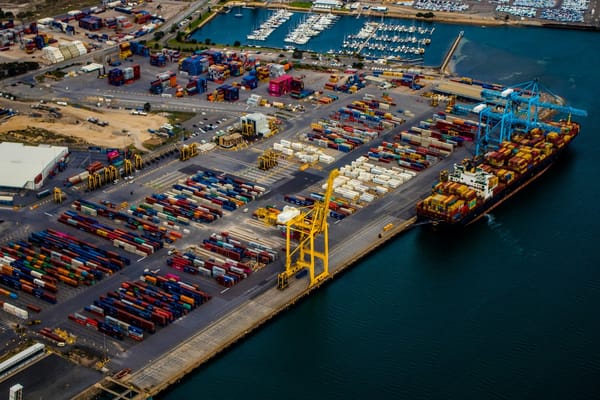
The Pacific corridor is where Canada’s global trade exposure is most concentrated and most consequential. Vancouver handles roughly one third of Canada’s trade in goods outside North America, and Prince Rupert has built a position as one of the closest North American ports to Asia, with direct CN rail access to interior Canada and the US Midwest. The strategic significance of that position extends beyond container volumes. Prince Rupert reported in 2024 that the port supplies approximately 13 percent of South Korea’s and nearly 25 percent of Japan’s total LPG imports. That makes parts of Canada’s marine infrastructure directly relevant to Indo-Pacific energy security, not just to domestic logistics. It is a dimension of Canadian trade that seldom appears in domestic financial analysis, and it carries its own set of geopolitical considerations as Asian energy markets evolve and Canada works to diversify its export relationships.
The 2025 trade environment added urgency to that diversification question. US tariff actions affected a broad range of Canadian goods, while Canada-US trade relationships that had operated under assumptions of relatively frictionless access came under renewed scrutiny. The Atlantic corridor responded with particular energy. Port Saint John tied its recent container growth to a trade diversification narrative, marketing itself as an alternative route for Ontario-origin cargo seeking non-US market access. The federal government framed the $1.16 billion Canada Infrastructure Bank commitment to Montreal’s Contrecœur expansion in terms of national trade resilience, not just capacity. Whether these responses produce durable diversification or represent a short-term adjustment to a temporary disruption is a question the data will answer across several years, not several months.
The Arctic dimension generates more strategic discussion than the infrastructure currently supports. Interest in northern routes has grown for both security and climate reasons, as reduced summer sea ice makes certain passages viable for longer periods each year. Canada’s official transport mapping, however, still describes a northern marine system anchored by Churchill, Iqaluit, and Tuktoyaktuk, with Churchill and Iqaluit the only deep-water Arctic ports. The northern marine economy remains primarily about community supply, annual resupply sealift, and support for remote resource activity. It is not a commercially developed trans-Arctic trade artery, and the gap between strategic aspiration and infrastructure reality is significant. For anyone allocating capital in that space, the implication is concrete: Arctic shipping is a multi-decade public infrastructure commitment dependent on sustained federal funding for port capacity, navigation systems, and search and rescue, not a near-term commercial opportunity that private capital can underwrite on its own timeline.
The environmental and regulatory dimension of global shipping is moving in ways that will affect Canadian trade flows. The International Maritime Organization’s 2023 strategy targets net-zero greenhouse gas emissions from international shipping by or around 2050, with meaningful carbon intensity reductions required by 2030. EEXI and CII ratings for vessels became mandatory from January 2023, creating measurable performance requirements that affect vessel values, operating costs, and route economics. Green shipping corridors, where governments and industry coordinate cleaner fuels and port infrastructure along specific trade routes, are being developed globally. Canada has not yet established a major one, but the regulatory trajectory is clear enough that Canadian ports and their financing structures will need to treat decarbonization as a commercial reality rather than a long-term aspiration.
The practical conclusion for a finance audience is that marine infrastructure in Canada cannot be underwritten through a standard infrastructure lens. These assets are long-lived and strategically important, but they sit at the intersection of labour risk, geopolitical exposure, regulatory change, and climate physical risk that conventional infrastructure models are not built to price. The system’s concentration is the specific thing to underwrite against. Two Class I railways move most of the cargo reaching and leaving Canada’s major ports, and a small number of gateway facilities handle a disproportionate share of national trade. That structure should change how these assets are stress-tested: correlated disruption across corridors is not a tail scenario to acknowledge and set aside, but a base case that 2024 already priced in real time. The financing structures that hold up will be the ones that treated it that way before the year that proved it.