Finance and the Ocean Are One System
A fishing boat belongs to somebody, feeds a family, and rests on a stock that may or may not be there next year. The divisions between those things are ours, not the ocean's.

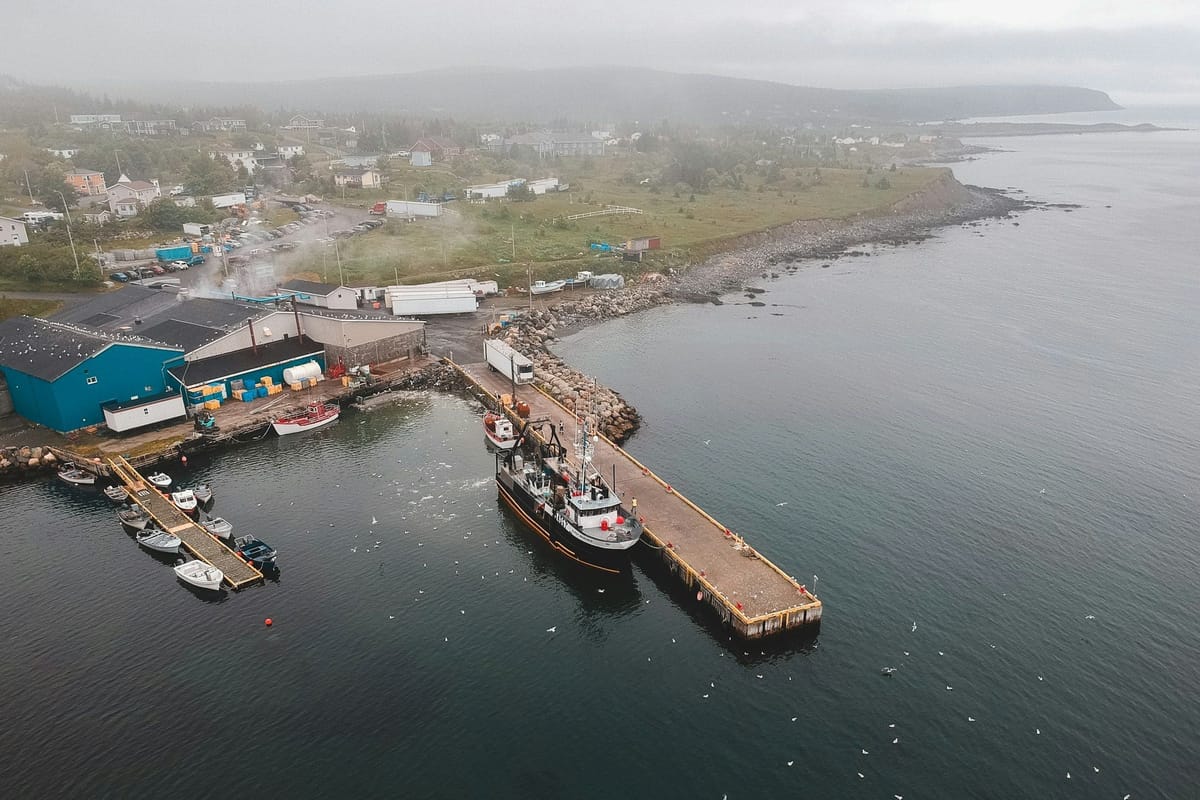
A fishing boat belongs to somebody, feeds a family, works inside a quota, rests on a stock that may or may not be there next year, operates in waters where Indigenous rights and governance apply, and answers to public expectations about food and stewardship. A port leases land to terminal operators, carries the country's trade, alters the habitat it was built into, and anchors a town that grew up around it. A bank loan sits behind both of them, and behind that loan a board approved the risk appetite that governs it, ratings agencies and the bank's own analysts spent years on the industry, and all of that was distilled into the lending guidelines that reach the borrower. What the loan could consider had been decided further upstream, by people writing rules about credit risk, deciding what counts as security, setting the time horizon, and drawing the line between consequences that belong inside the decision and consequences that belong to somebody else.
We have built institutions by dividing the world into pieces small enough to manage. Fisheries departments manage fisheries. Environmental regulators write environmental rules. Banks assess credit, insurers price risk, accountants record assets and liabilities, scientists measure what is happening in the water, companies produce and sell, and governments tax, regulate and spend. There are good reasons for that specialization and a modern economy could hardly function without it. We made the divisions. The systems stay connected whether the institutions arranged around them recognize it or not. From inside any one of them the separation looks like a fact about the world instead of a decision about how to organize the work. It is only from a distance that the pieces resolve into the single system they always were.
I stood at that distance once, quite by accident. In 2002 I volunteered for an Earthwatch expedition in Iceland that HSBC made available to its employees, and one day our group climbed out of the valley we were in onto a ridge. When I got to the top and looked across, I could see the whole valley at once. Wherever the rivers ran there was a band of green. Everywhere else was lunar grey. We had spent the morning wearing mesh nets over our heads because the insects near the water were so bad. From the ridge I could see that nothing grew unless it was close to the river.
The ocean does the same thing for our whole planet. It is so large, and so many things act on it at once, that the causes and effects cannot be traced the way they can in one valley in Iceland. A fisheries department sets the quota. A bank credit committee decides who can buy a license. A supermarket buying office sets the price. A household chooses what is for dinner. All of that lands on the same fish. A coastline gets zoned by a municipality, insured by one company, mortgaged by another, built on with federal money and worn down by a warming atmosphere, and it does not sort any of that into categories. All of it ends up in the same water, and once it does there is no telling which decision did what.
Finance sits inside all of this. Every fishing vessel, port terminal, aquaculture site, ferry, coastal hotel and offshore energy project has a financial architecture behind it. Someone provides the equity, someone lends the money, someone insures the asset, and someone decides what risks matter, what can be pledged, what return is required and how far into the future the numbers should extend.
I spent more than thirty years inside that architecture, deciding some of those things. In 2004 we had a client with a scrapyard on the harbour. They did a healthy business taking in construction debris, stripping out the metal and reselling it, and barges came alongside to carry it away. When they came in for more financing, the appraiser felt the land was worthless because he thought heavy metals from the debris were leaching into the soil, and went further, saying the liability for cleaning it up would fall to the lender. That left us with no collateral and, on his reading, a remediation bill. The borrower was pretty upset, given all the containment and remediation measures they had in place. I knew the appraiser was wrong. I then engaged an environmental consultant for a Phase I and Phase II assessment to determine the level of contamination. The good news is that the measures were sufficient, and the ground under the yard was clean. We approved the financing as they had requested.
After Iceland I found myself commenting on the environment in all of my files, generally as a liability. The Phase I and Phase II told me the condition of that land. There was a standard for it, a consultant who performed it, a report that went in the file and a rule about what to do with the answer. All of that machinery exists for a few acres on the harbourfront. There is no ready equivalent for the ocean. Scientists assess fish stocks and publish what they find, but nobody orders one for a loan, nobody scopes it to the borrower, and nothing in the credit process says what to do with the answer.
A lender knows what to do with a boat. It has a value, somebody owns it, and if the loan goes bad somebody will buy it. The fishery that boat depends on is a different matter. Nobody owns it, so nobody can pledge it, and if somebody spent money rebuilding it the benefit would go to every license holder on that coast, including the ones who spent nothing. A wetland is the same kind of thing. It keeps water out of people's houses and turns up on nobody's balance sheet as the thing doing the work. An Indigenous Guardian program produces knowledge that makes stewardship better, and no lender has a way to book it. Meanwhile a business that runs those systems down can do perfectly well, because part of what it costs lands on somebody else.
This is where blue finance starts, though the term usually means something narrower. Blue bonds, sustainability-linked loans, blended structures and conservation funds all matter, because they move money toward particular ocean outcomes. But the instruments are the easy part. The harder questions sit underneath them. What counts as an asset. Who decides what risk means. Who owns the benefit when a system recovers, and who pays when it does not. How anybody funds work that takes decades when the decision in front of them runs five years.
Those questions do not stay inside finance for long. What a lender can consider is set by regulators, so some of the answer sits with them. Nothing gets into a credit decision until somebody has measured it, so some of it sits with science. And a great deal of Canada's coastline sits in territories where ownership and authority and stewardship cannot be pulled apart from the money, which puts Indigenous rights and governance in the middle of this instead of off to one side. That is why one essay here is about a blue bond and the next is about ocean acidification, or how a First Nation finances infrastructure, or whether anybody checks what happened in the water after the money was labelled blue.
Finance is very good at describing some things and not others. It can value a ship, calculate a probability of default and price the capital an investor will want against both. The ocean absorbs heat, stores carbon, moves goods, feeds people and holds communities in place, and it shows up in the accounts only indirectly, through the things built on top of it.
Blue finance is an attempt to get some of those relationships back into a decision. Sometimes that means a new instrument. Just as often it means better measurement, a different rule, or a change in how somebody understands a risk. And sometimes finance is the wrong tool, and saying so is part of the work. There is a pull in sustainable finance toward assuming that once a problem has a name the next job is to find something investable, and the ocean does not always cooperate with that. Some things get done by public spending. Some get done by regulation, or by limiting an activity, or by people who look after a place for reasons that never turn into a return. Knowing where finance can help means knowing where it cannot.
What interests me is the ground where these meet. A coastal community whose economy rests on conditions in the water that appear nowhere in the documents governing the money moving through it. Canada has three oceans and the longest coastline in the world, and very little written about how its financial system meets them. The essays here follow those connections through particular places, projects and decisions, asking what finance can reach, what it misses and what should remain outside it. I am still working out the answers, and I expect them to be more complicated than either the instruments or their critics suggest.