Aquaculture: Environment, Science, and the BC Transition
Open-net pen salmon farming ends in coastal BC on June 30, 2029. DFO has launched a systematic review of the sea lice evidence, the peer-reviewed literature points in several directions, and no independent analysis exists of what replacing BC production would cost.
Open-net pen salmon farming in British Columbia is one of the few resource management questions in Canada where federal policy, peer-reviewed science, Indigenous governance, and commercial interests point in four different directions at once. On most of the central environmental questions, the answer is not that one side is right. It is that the evidence is more complicated than either side typically allows.
That complexity is not a background consideration for anyone assessing the sector. Environmental risk here is a core operating variable that determines biological performance, regulatory stability, market access, and whether existing business models remain viable.
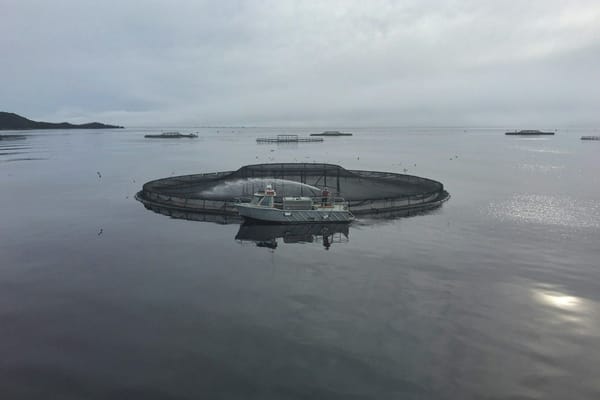
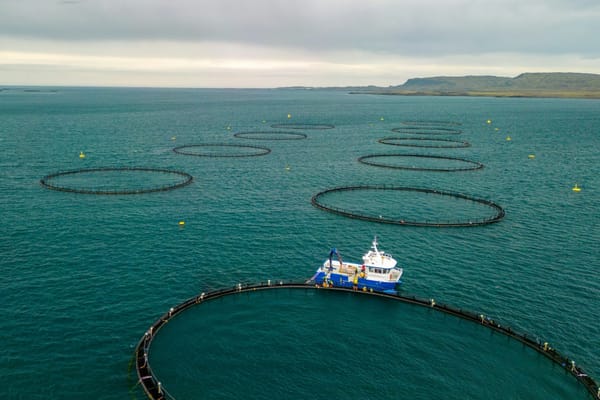
The clearest distinction in environmental terms is between open-net pens and land-based closed containment. Open-net pens place fish in marine cages open to surrounding seawater. Whatever goes in, feed, feces, pathogens, parasites, and chemicals, and whatever comes out, escaped fish, disease organisms, and waste, moves freely between the farm and the water around it. Land-based recirculating systems raise fish in tanks on land with controlled water treatment and limited marine contact. The two profiles are materially different, and land-based systems are not impact-free. They move the risk from marine interaction toward water treatment, energy consumption, sludge management, and infrastructure failure.
Organic waste and nutrient loading are among the better established mechanisms in open-net finfish farming. DFO's BC monitoring report confirms that feces and excess food accumulate below and around marine finfish sites, and that sufficient accumulation alters the seabed or affects surrounding organisms. The same report states that 80 to 90 percent of sites were below impact thresholds in the most recent reporting year reviewed here, and that all farms at peak production are required to conduct benthic monitoring. Two caveats apply. This is a BC marine finfish reporting system, not a Canada-wide finding. And the existence of thresholds and audit systems does not establish that those thresholds are protective enough, particularly at cumulative regional scales where multiple farms operate in adjacent waters.
Sea lice and their interactions with wild salmon are where description gives way to live scientific dispute. DFO's 2025 Science Advisory Report acknowledges that sea lice have been linked to effects on wild salmon, states that uncertainty remains about the contribution of salmon farms to those effects, and launches a phased systematic review to assess the evidence more rigorously. That is a significant official signal. It does not say there is no risk. It says the evidence base is important enough, and contested enough, to warrant a structured independent review instead of a settled regulatory conclusion.
The peer-reviewed literature points in more than one direction. A 2024 paper in Science Advances argued that three pathogens prevalent in farmed Atlantic salmon in BC spill over to wild Pacific salmon and are linked to negative impacts on wild fish. Earlier DFO risk assessments in the Discovery Islands context reached lower-risk conclusions for some specific pathogens under defined scenarios, including a 2017 finding of minimal risk from a particular virus to Fraser River sockeye under the conditions assessed. These are not straightforward opposites. They address different agents, different places, and different methods. Together they show why the question remains unsettled scientifically as well as politically, and why anyone claiming certainty in either direction is overstating what the evidence supports.
The federal government's June 2024 policy statement resolved the political question in British Columbia without resolving the scientific one. Open-net pen salmon farming in coastal BC will be banned by June 30, 2029. Existing licences were renewed for five years from July 1, 2024, and new salmon licence applications are limited to closed-containment systems. DFO's draft transition plan, released in September 2024, was presented as a basis for engagement and not a finished blueprint, and the public sources reviewed here do not confirm that a final transition plan was in place as of early 2026. The policy direction is clear. The implementation architecture is not, and that gap is where the uncertainty sits for operators, communities, and anyone with capital exposed to BC salmon farming.
The transition raises questions that neither the policy statement nor the science debate addresses. Land-based systems cost more to build, consume considerably more energy, and have not been demonstrated as commercially viable at the scale BC open-net farming currently operates. Canada has operational examples in Kuterra on northern Vancouver Island and Sustainable Blue in Nova Scotia, both at smaller scale. Quebec's AquaBoreal received ministerial approval in March 2026 and remains a planned project, not an operating farm. The public record does not contain a credible independent analysis of what replacing BC marine production would cost at full scale, or who would finance it.
That absence is itself a finding. A hard deadline has been set for an industry whose replacement capital must be committed years in advance, against a production model with no Canadian precedent at that scale and no operating history for a lender to price against. Five years of licence remain. Financing, building, and proving the assets that would replace them takes longer than that.
Climate change cuts across all of these issues in ways that are becoming harder to treat as background. A 2024 Scientific Reports study concluded that climate change and marine heatwaves are likely contributing to increasing salmon mortalities in Canada and other producing countries. Mowi's 2025 Canada East experience, where warm water and low oxygen drove mortality and early harvests, is a recent company-level illustration of the same pressure. A 2025 paper in FACETS described climate change as both a risk and an opportunity framework for Canadian mariculture. The water is also changing chemically. Hatchery operators on both coasts are already managing ocean acidification in their intake water. Climate exposure is a direct operating and valuation issue in Canadian aquaculture, not a long-term abstraction.
One final distinction worth carrying forward. The most intense environmental debates in Canada centre on open-net salmon farming in British Columbia, and they should not be generalized to PEI mussels, BC oysters, Quebec freshwater trout, or Atlantic shellfish operations. DFO's own scientific framing treats marine finfish, shellfish, and freshwater aquaculture as different environmental categories with different risk profiles, different regulatory frameworks, and different bodies of evidence. The BC debate is real and consequential. It is also specific, and treating it as representative of Canadian aquaculture as a whole produces a less accurate picture than the sector warrants.