A. Why Oceans Matter
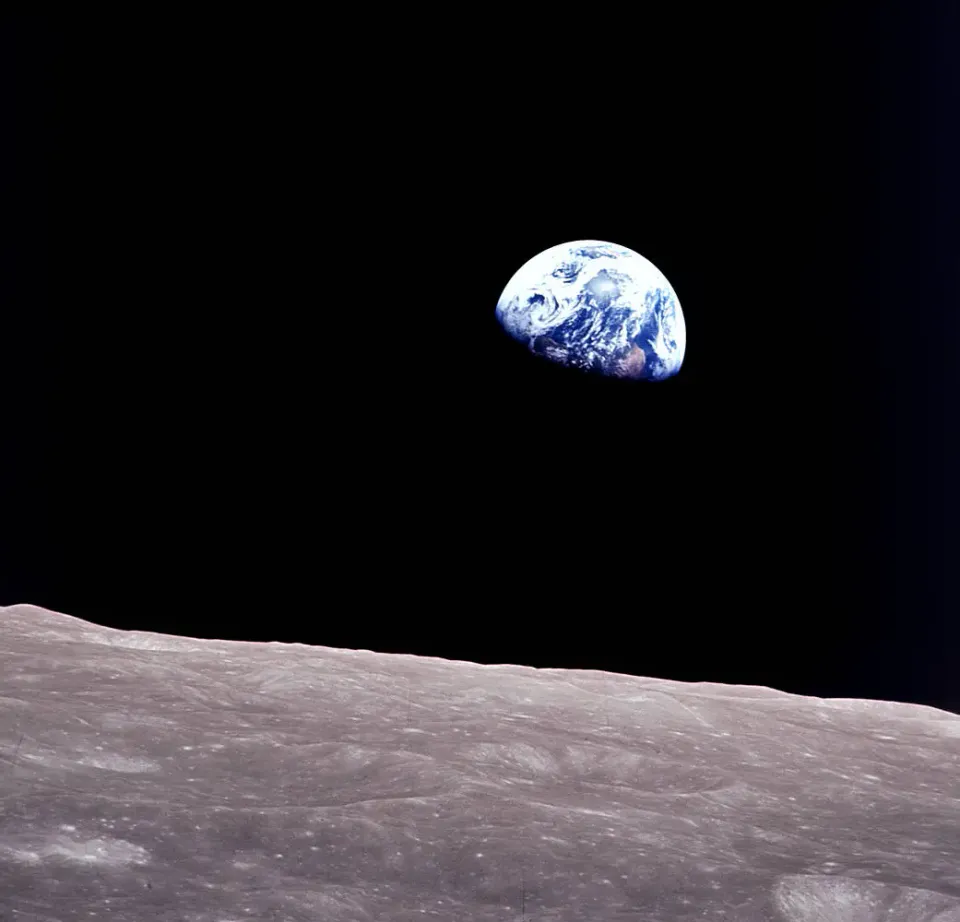
The photograph Earthrise marked the first time humans were able to see their home planet from beyond their own sky. Taken by astronaut William Anders during the Apollo 8 mission in December 1968, it showed Earth as a small blue sphere rising above the grey horizon of the Moon, its edge caught by a narrow band of sunlight against the deep blackness of space. Nature photographer Galen Rowell later called it “the most influential environmental photograph ever taken.” The image was captured almost by accident, as Anders turned the camera toward the window while photographing the surface of the Moon. The view lasted only seconds, yet it altered how people understood the planet and its place in the universe. The image shaped public understanding, informed scientific inquiry, and influenced early efforts at global cooperation.
What Earthrise suggested was permanence. The planet appeared complete and self-contained against the vastness of space. From that distance, Earth looked whole and enduring. Its systems appeared stable. That appearance masked a dependence on finely balanced physical and chemical processes, calibrated over billions of years, within which life coevolved inside narrow bounds. The image invited awe and left room for the belief that something so large and ancient would be resilient by default. Awareness was immediate, but institutions took much longer to absorb what the image implied, and even longer to act on it together. Earth is finite, while economic and institutional systems have been built around expectations of continued expansion. That tension is most apparent in natural systems that change slowly, respond in non-linear ways, and reveal damage only after thresholds have been crossed. Earthrise showed a planet without showing the conditions that make it habitable. A photograph cannot show the feedback loops, time lags, and cumulative pressures that determine whether stability persists. The image made it clear that stability cannot be taken for granted. Institutions have been slow to absorb that reality, in part because coordinating around environmental systems involves complexity, trade-offs, and shared responsibility across many actors. Like any complex system, the Earth requires ongoing maintenance.
Maintaining that stability calls for decision-making frameworks that operate over decades rather than electoral cycles or quarterly earnings seasons. It also calls for financial systems that recognize cumulative and systemic risk, alongside governance structures able to carry responsibility when harm is distributed across borders and generations. Some communities have long understood this relationship. Coastal and Indigenous societies recognize that environmental degradation leads directly to economic and social collapse as livelihoods depend on local systems remaining within a narrow range. This understanding grew out of lived dependence on systems that respond quickly when limits are crossed. Science later reinforced this understanding by establishing the link between greenhouse gas emissions, rising temperatures, and changes in ocean systems. Policy responses followed as awareness grew, including early efforts such as the Kyoto Protocol and later agreements like the Paris Accord. These efforts remain shaped by political cycles, uneven enforcement, and institutional designs that struggle to manage shared global systems over long time horizons.
The limits of existing institutions are especially visible in the ocean, where no single institution bears responsibility for outcomes that emerge gradually and at a global scale. The ocean is central to planetary stability, yet sits outside the national legal, budgetary, and accountability frameworks that normally provide protection. Each local body responds to local incentives, sees only part of the system, and defers accountability for outcomes that accumulate over time. Degradation continues because no single institution is responsible for acting on behalf of the whole over the time horizons that matter.
At the same time, economic power has shifted. Large public corporations now control resources, infrastructure, and capital flows comparable to those of many nation states. Some acknowledge a role in environmental stewardship, while still operating within fragmented fiduciary frameworks. In the United States, directors have traditionally understood their duties primarily through shareholder value, reinforcing a focus on near-term financial performance. In Canada, courts have clarified that directors owe their duties to the corporation itself and may consider the interests of shareholders, employees, communities, and the environment when assessing long-term health. This provides latitude without creating a consistent global mandate. Boards operating across jurisdictions face differing expectations about whose interests matter, how far into the future risk should be assessed, and how environmental degradation should be weighed alongside financial return. In practice, these differences surface less as ethical debates than as boundary questions about what is considered relevant to decision-making.
If Earthrise were taken today, it would show polar ice loss, altered coastlines, and changes in land cover reflecting the accumulated effects of warming and resource use. The signs of strain would be visible from a distance. If it were taken again fifty years from now, assuming current trends persist, we would likely see less vibrancy in the greens and blues, less white at the poles, and browner coastlines. The image would not show how much pressure the planet’s regulating systems are under.
Life on Earth began in the ocean, where simple life forms emerged and gradually became more complex before migrating onto land. Over roughly four billion years, ocean processes shaped the atmosphere, contributed much of the oxygen now present, and regulated the balance of gases. The ocean’s capacity to absorb and redistribute heat created the climatic conditions within which agriculture, trade, and settlement developed. Stable growing seasons, functioning ports, and predictable weather patterns depend on processes unfolding far offshore and well below the surface.
That stabilizing role has long supported human societies and is now under increasing strain, as the ocean has absorbed more than ninety percent of the excess heat added to the Earth system since the industrial revolution. This has moderated warming on land while altering marine conditions. As ocean waters warm and expand, sea levels rise, currents shift, and chemistry changes as carbon dioxide dissolves into seawater. Marine ecosystems respond to these changes. Coral reefs bleach, shell-forming organisms weaken, and species move in search of conditions they can tolerate. Coastal ecosystems that once absorbed shock, including mangroves, seagrass beds, and kelp forests, lose resilience, leaving shorelines more exposed to erosion, flooding, and storm damage.
These changes begin in the ocean but do not remain there. Their effects extend inland through food systems, trade routes, infrastructure planning, insurance markets, and public finances. The conditions that supported human societies for thousands of years can no longer be assumed.
Finance and ecology have typically been treated as separate domains, informing different decisions, operating on different timelines, and drawing on different forms of expertise. That separation no longer holds if institutions are expected to mobilize in response to environmental change. Financial decisions shape ecological outcomes, and ecological change now feeds directly back into financial risk, asset values, and institutional stability. In this setting, finance cannot be treated as neutral. Capital flows determine which industries expand, which practices persist, and which activities face limits. Investment and lending decisions shape whether damaged habitats are restored, whether infrastructure is built for historical conditions or emerging realities, and whether risk is recognized early or carried forward until losses become unavoidable.
This is where blue finance comes into focus. Blue finance aligns financial systems with the physical conditions that support stability by recognizing how ocean systems function, how they are changing, and how financial decisions influence those changes over time. In doing so, it places responsibility for ocean stability within the financial system itself, treating the ocean as foundational infrastructure for the global economy.
This book is written for those who carry some part of that responsibility. It is intended for lenders evaluating exposure to coastal change; investors assessing risk across shipping, fisheries, ports, and offshore energy; policymakers shaping marine development and infrastructure rules; development agencies and foundations supporting coastal resilience; scientists interpreting signals from a changing ocean; and coastal communities and Indigenous Nations whose knowledge and stewardship remain essential.
The chapters that follow examine how ocean change affects capital, risk, and governance. They consider where existing financial frameworks fall short and how they can evolve to support long-term resilience. The aim is to apply technical discipline more fully in a world where ocean stability cannot be assumed.
Earthrise helped humanity see the planet clearly. Since 1968, the financial, legal, and governance institutions needed to care for it have yet to evolve in ways equal to that challenge. The future of ocean stewardship will be shaped in the space between awareness and action, where finance now operates.